


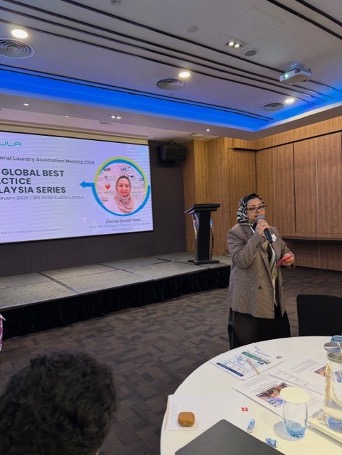


Zarina Ismail Hon is the Co-Founder and Chief Executive Officer of Drop & Wash Sdn Bhd, Malaysia’s pioneering eco-friendly wet-cleaning chain and an accredited Social Enterprise. A litigation lawyer by training since 1998, Zarina co-founded Drop & Wash in 2008 together with Omar Adam Hon with a bold vision: to make professional textile care safer for the environment while creating meaningful employment opportunities for marginalized communities.
Under her leadership, Drop & Wash became the first operator in Malaysia to adopt the Lagoon™ Woolmark Wet Cleaning system, positioning the company as a pioneer in toxic-free garment care. The company operates within Malaysia’s RM2.79 billion laundry industry and focuses on upper-middle to high-income consumers in the Klang Valley. Despite strong competition, Drop & Wash maintains a loyal customer base and generates approximately RM1.8 million in annual revenue with steady projected growth.
Beyond commercial success, Zarina is widely recognized for integrating sustainability and social impact into core business strategy. Drop & Wash operates under an employment and micro-franchising model that empowers B40 communities, the urban poor, refugees, and other marginalized groups through job creation and upskilling. The company holds Social Enterprise Accreditation and Tax Exemption Status and has received international recognition through CINET’s Global Best Practice Awards.
Zarina is passionate about sustainable innovation, industry modernization, and regional expansion across Southeast Asia. Her long-term ambition is to build the largest wet and eco-cleaning chain in Malaysia while nurturing a new generation of socially conscious “laundrepreneurs.”
Can you please share with us your current position/job and profile of the organization you work for?
I am representing Drop & Wash Sdn Bhd, an eco-friendly professional textile care company based in Malaysia and an accredited Social Enterprise founded in 2008. Drop & Wash was established with a dual mission: to make professional textile care safer for the environment and to empower marginalized communities through meaningful employment and entrepreneurship.
We were among the pioneers in Malaysia to adopt the Lagoon™ Woolmark Wet Cleaning system, positioning ourselves as a toxic-free alternative to traditional perc-based dry cleaning. From the beginning, our goal has been to integrate sustainability, innovation, and social impact into the core of our operations. Today, Drop & Wash operates within the premium garment care segment and continues to advocate for environmentally responsible best practices within the Malaysian textile care industry.
2. In which countries and market sectors of Professional Textile Care did you work and did you gained experiences?
Our primary operational experience is in Malaysia, particularly within the Klang Valley, where we serve both individual consumers and corporate clients.
Our services span B2C garment care, on-premise laundry (OPL), door-to-door solutions, and selected B2B hospitality and corporate accounts.
Through advisory relationships and industry engagement, we also monitor developments across Southeast Asia, particularly in Indonesia, Thailand, and the Philippines, where the premium and sustainable textile care segments are evolving. This regional perspective allows us to understand both mature and emerging PTC market dynamics.
3. Could you please describe the most important characteristics and trends of the current PTC markets in terms of customer/market demand characteristics and trends?
The Malaysian PTC market is undergoing gradual transformation. While the broader laundry industry contributes significantly to the national economy, the on-premise and premium segments remain relatively underdeveloped compared to international benchmarks.
Customers increasingly demand convenience, reliability, and transparency. Door-to-door services, digital communication channels, and faster turnaround times are becoming standard expectations. At the same time, there is growing awareness regarding sustainability and chemical usage, particularly among younger and environmentally conscious consumers.
Another important trend is the shift toward garment longevity. Consumers are beginning to understand that professional textile care is not merely about cleaning but about preserving value and extending the life cycle of clothing.
4. What do you see as the most important success factors for todays PTC companies?
In today’s environment, success depends on consistency, trust, and adaptability. Textile care remains a relationship-driven business; customers return when garments are treated with care and quality is consistent.
Operational discipline and standard operating procedures are critical. So is workforce development. Skilled, motivated employees directly influence service quality and customer satisfaction.
Furthermore, sustainable differentiation is becoming increasingly important. Companies that proactively transition away from harmful solvents and adopt responsible technologies are better positioned for long-term resilience.
5. What are your organization objectives and when would you consider your organization to be successful?
Our objectives are to increase the adoption of wet-cleaning practices in Malaysia, reduce reliance on harmful chemicals such as perchloroethylene, and expand socially inclusive employment within the textile care industry.
We measure success not only in operational stability but in environmental and social impact. As a Social Enterprise, we focus on empowering B40 communities, the urban poor, refugees, and other marginalized groups through employment and licensing opportunities.
Success for us means demonstrating that professional textile care can simultaneously protect the environment and uplift communities.
6. What do you consider the most important future demands of clients in PTC markets?
Future clients will demand seamless digital interaction, faster logistics, and complete transparency in cleaning methods. Sustainability will become a baseline expectation rather than a premium feature.
Customers will also expect integrated garment care solutions—cleaning, minor repairs, finishing, and responsible disposal—all delivered conveniently. The industry must be prepared to operate as a full-service wardrobe care partner rather than simply a cleaning provider.
7. What are key issues for the PTC companies to fulfill future demands of clients and PTC markets?
The industry faces several structural challenges. There is a growing skills gap, rising operational costs, and increasing regulatory pressure related to environmental compliance. Additionally, many operators remain technologically behind, relying on outdated processes.
To meet future demands, companies must invest in staff training, adopt digital tools, modernize equipment, and improve operational efficiency. Industry collaboration and knowledge-sharing will also be essential.
8. How important is sustainability / circularity for your current business performance and what do you do to improve your performance as an organization?
Sustainability is central to our business model. We operate under a strict No Toxic Solvent policy and avoid the use of perchloroethylene, which remains prevalent in the industry.
Our environmental initiatives include wet-cleaning systems that replace chemical solvents, wastewater treatment protocols, reduction of plastic covers, and encouraging hanger reuse. These practices not only reduce environmental harm but also align with our social mission of protecting both people and planet.
We continuously seek technological upgrades and process improvements to enhance both sustainability and service quality.
9. Do you see sustainability as an important driver for (new) business or as a factor for saving costs?
Sustainability is both a strategic driver and a long-term stabilizer. It differentiates us in a competitive market and builds trust with customers who value responsible practices.
At the same time, efficient systems, reduced chemical reliance, and optimized logistics can contribute to operational stability. More importantly, sustainability reduces regulatory risk and aligns the business with global environmental goals.
10. Do you see technical innovation as a key factor to enhance your business performance, and what technologies are essential to provide sustainable and profitable PTC services in the future?
Yes, technical innovation is essential. Advanced wet-cleaning technology, digital workflow systems, predictive maintenance tools, and AI-driven logistics solutions will define the next phase of industry development.
Innovation ensures quality consistency, reduces waste, and increases operational transparency. Companies that fail to modernize risk becoming obsolete.
11. What do you see as the most important innovations of the (near) future and how do you believe these innovations will change the way the industry operates?
The most impactful innovations will likely include AI-enhanced route optimization, smart machinery with integrated diagnostics, data-driven production management, and customer-facing digital platforms.
Additionally, advancements in eco-detergents and circular textile initiatives will reshape how the industry contributes to sustainability goals.
12. According to many publications, a transformation of the PTC industry towards more customer and IT driven processing, is seen as essential to be successful in the future. What is your policy to adapt your business/service model to changing market demands?
We combine strong operational SOPs with digital communication tools and structured logistics systems. Technology is implemented to enhance efficiency while preserving human service quality.
Our approach is to integrate innovation carefully—ensuring reliability, consistency, and trust remain at the forefront.
13. We have seen an enormous increase in scale of operation of PTC companies. Do you see there will be attractive opportunities also for the more smaller companies and what is needed for small companies to be successful?
Yes. Smaller companies can succeed by specializing, differentiating through sustainability, or joining cooperative networks. Scale provides advantages, but niche positioning and operational excellence remain powerful tools for competitiveness.
14. How do you feel the PTC industry can take more market share in the markets of textile cleaning, compared to domestic washing?
The industry must reposition itself as a convenience and sustainability partner. By emphasizing garment longevity, professional care quality, and environmental responsibility, professional textile care can become relevant for everyday garments—not only special occasions.
Education and competitive pricing strategies will also play important roles.
15. What do you see as major opportunities for the professional laundry and cleaning industry for the longer term future?
Long-term opportunities include integration into the circular textile economy, ESG-aligned corporate partnerships, digital transformation, and regional expansion within Southeast Asia.
The industry has the potential to become a sustainability leader within the broader fashion ecosystem.
16. What do you see as major threats for the PTC industry in the coming years?
Labor shortages, regulatory tightening, rising utility costs, and failure to modernize pose significant risks. Consumer price sensitivity and global economic volatility may also affect growth.
Collaboration and modernization will be essential to mitigate these threats.
17. What would you say industry (inter-)national associations should do to support the PTC industry professionally, now and in the future?
Associations should promote education, certification, sustainability standards, research, and global collaboration. They play a critical role in elevating professionalism and ensuring knowledge-sharing across markets.
18. What is your vision on the future perspective of the industry?
The future PTC industry will be sustainable, digitally integrated, and socially inclusive. Professional textile care will transition from being a reactive cleaning service to a proactive sustainability and garment preservation partner.
19. What is your key-message to your professional PTC colleagues for now and in the future?
Modernize responsibly. Invest in your people. Embrace sustainable innovation. Collaborate across borders.
The future of professional textile care belongs to companies that balance quality, technology, and environmental stewardship.


