


Professional Textile Care can be an excellent alternative to washing at home for part of Dutch society. That was one of the conclusions of a recent study of Textile Care Rearch, assigned by the Dutch associations and CINET, Rijkswaterstaat (a government body) and the suppliers Electrolux, Christeyns and Safechem.
Further findings included:
– Identification of the ideal customer profiles such as Young Professionals and Dual earners with kids.
– The best turnaround time.
– As concluded in scientific studies, also in practical circumstances 24% CO2 savings are possible.
– The impact of Customer experience.

Customer experience
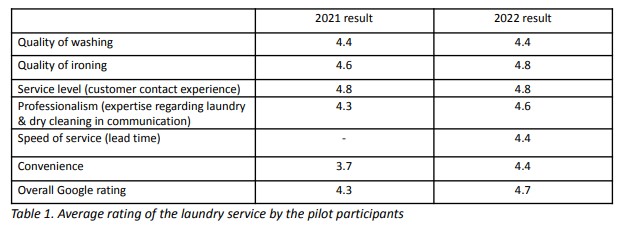
Especially customer experience is the dominating factor for good retention rates. As was concluded in an earlier project (2021), the biggest challenge for a modern laundry service is to remove all friction in the customer experience which increases the quality and convenience to use the service. As the table below shows, convenience was evaluated much better in this pilot, but several participants still indicated that ‘staying at home for pickup/delivery’ can be a frustration. This element has a direct impact on the perception of costs/benefits of the service. As soon as any form of frustration occurs, the experience quickly changes, and customers start considering whether this service is worth the money. In line with this point, an effort has to be done in profiling the service. Participants currently perceive outsourcing laundry as a luxury service, while the service should be experienced as a contribution to a cleaner world while enjoying time off with family and friends. There is still a long way to go here, the sector will have to work on its branding to change the perception step by step.
Turnaround time
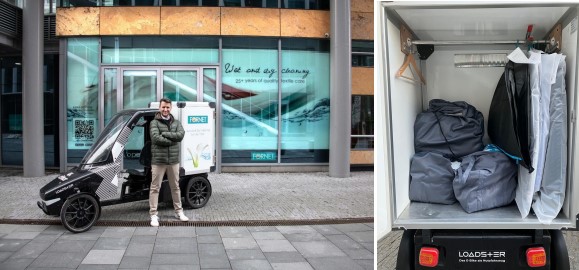
As in the 2021 study, it was concluded that the turnaround time remains a point of attention. The process was designed for a 72-hour turnaround (between pickup and delivery), but 48 hours’ turnaround time would be better for the participants. This can easily be implemented in the process at Fornet. The orders will go in and out of the shop faster which results in a better flow of garments on the work floor and so a more efficient process.
Sustainability benchmark at home vs. professional
Regarding the sustainability of domestic washing compared to professional cleaning, it can be concluded that a CO2 reduction of 11.4% was achievable in this specific situation. The load factor at Rentex is ~70% due to the way they sort & separate the customer batches, so the savings could be increased even further if this would be optimized. This confirms that in an optimal setting, the 24% CO2 savings as concluded in TKT’s scientific research from 2019 are possible.
Garment lifetime benchmark
The general conclusion for the quality benchmark on the lifetime of the six selected garments is that there are many parameters that influence the lifetime of clothing. The items that were professionally cleaned remained closest to the original, especially the high-end chino, polo, and the simple buttoned shirt. There were also clear differences between the two consumers. Depending on washing habits and the condition of the machine at home, there is a lot of variation in the result. This is logical. A consumer has limited knowledge of textile cleaning and considering today’s busy lifestyles, people do not make time to apply the ideal washing process for the clothing mix. In a professional setting, where work is done at scale, the ideal process can be applied more easily. Moreover, washing at scale results in a good loading factor, which lowers the CO2 emissions and water consumption per kilo. If a consumer splits the laundry into small batches to apply the best process, this results in a lower load factor and therefore a higher footprint.