




Can you please share with us your current position/job and profile of the organization you work for?
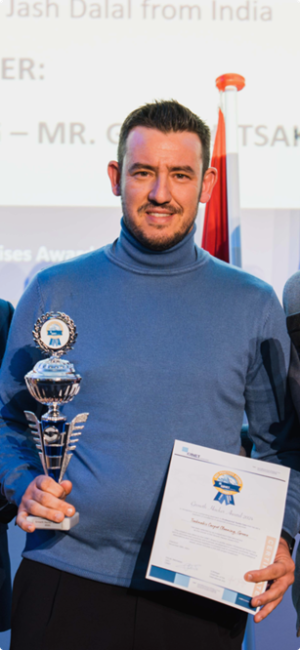
I am George Tsaknakis, CEO of Carpet Clean Tsaknakis, one of the leading professional textile care companies in Greece. With more than 20 years of experience in the Professional Textile Care (PTC) sector, I have focused on building a modern and sustainable textile service organization.
Our company has grown to become the largest carpet cleaning company in Greece, processing approximately 60,000 carpets annually. Over the years we expanded our services by creating three additional operational divisions: an Industrial Laundry department, an Upholstery and bio-cleaning department, and a Textile Dyeing department.
Our strategy combines operational excellence with sustainability and technology. We invest heavily in renewable energy, automation, ERP systems, artificial intelligence for order management, automated routing logistics, water recycling systems, solar hot water panels, and photovoltaic installations in order to reduce environmental impact while increasing operational efficiency.
2. In which countries and market sectors of Professional Textile Care did you work and did you gained experiences?
Our main operational experience is based in Central Greece city of Larissa and suburbs. Through our services we support sectors such as hospitality, tourism, residential textile care, upholstery cleaning, and professional laundry services.
Working in a tourism-driven economy has allowed us to understand the high expectations of international clients regarding hygiene, sustainability, reliability and service quality. This environment has helped us develop strong operational processes and scalable textile care solutions.
3. Could you please describe the most important characteristics and trends of the current PTC markets in terms of customer/market demand characteristics and trends?
The PTC market is undergoing a strong transformation driven by sustainability, digitalization and efficiency.
Customers increasingly demand environmentally responsible services with measurable reductions in water consumption, energy use and waste production. At the same time digital technologies such as ERP systems, AI based order management and automated logistics are becoming essential to maintain efficiency and service reliability.
Another important trend is the integration of circular economy principles where companies extend textile life cycles and improve recycling and reuse practices.
4. What do you see as the most important success factors for todays PTC companies?
Success today depends on combining operational efficiency with sustainability and technological innovation. Key factors include energy efficiency, water management, automation, reliable logistics, digital process monitoring and strong customer relationships.
Companies that invest in renewable energy, efficient washing technologies and smart management systems will be able to control operational costs while maintaining high service quality.
5. What are your organization objectives and when would you consider your organization to be successful?
Our main objectives are to continuously expand our services while reducing our environmental footprint and improving operational efficiency.
Success for our organization means achieving sustainable growth, maintaining high customer satisfaction and continuously improving resource efficiency through renewable energy, water recycling and digital process management.
6. What do you consider the most important future demands of clients in PTC markets?
Future clients will expect transparency, sustainability and reliability. They will increasingly demand partners who can demonstrate measurable environmental performance, efficient logistics and high hygiene standards.
Digital integration, traceability and responsive service will also become increasingly important.
7. What are key issues for the PTC companies to fulfill future demands of clients and PTC markets?
The key challenges include rising energy costs, water consumption regulations, labor shortages and the need for technological investment.
PTC companies must adopt automation, digital systems and sustainable resource management in order to remain competitive.
8. How important is sustainability / circularity for your current business performance and what do you do to improve your performance as an organization?
Sustainability is a central pillar of our strategy. We have invested in photovoltaic systems, solar panels for hot water production, water recycling technologies and optimized washing processes to reduce water and energy consumption.
We also implement responsible packaging and waste management practices while constantly improving process efficiency through digital monitoring systems.
9. Do you see sustainability as an important driver for (new) business or as a factor for saving costs?
Sustainability is both a cost efficiency strategy and a business growth driver. Energy savings, water efficiency and waste reduction directly reduce operational costs.
At the same time many customers increasingly prefer environmentally responsible partners, making sustainability a strong competitive advantage.
10. Do you see technical innovation as a key factor to enhance your business performance, and what technologies are essential to provide sustainable and profitable PTC services in the future?
Technology is essential for the future of the PTC industry. In our company we use ERP systems for operational control, artificial intelligence tools for order management and automated routing systems for logistics optimization.
These technologies allow us to improve productivity, reduce waste and provide faster and more reliable services.
11. What do you see as the most important innovations of the (near) future and how do you believe these innovations will change the way the industry operates?
Future innovations will include AI based operational planning, smart textile tracking technologies such as RFID, advanced water recycling systems and fully automated processing lines.
These technologies will transform professional textile care into a highly efficient and data driven industry.
12. According to many publications, a transformation of the PTC industry towards more customer and IT driven processing, is seen as essential to be successful in the future. What is your policy to adapt your business/service model to changing market demands?
Our policy is based on continuous digital transformation. We have implemented an ERP system that integrates production, logistics and customer management while AI tools support order management and planning.
In addition automated routing systems allow us to optimize transportation efficiency and reduce fuel consumption.
13. We have seen an enormous increase in scale of operation of PTC companies. Do you see there will be attractive opportunities also for the more smaller companies and what is needed for small companies to be successful?
Yes, smaller companies can remain competitive if they focus on specialization, service quality and technology adoption. Modern digital tools allow smaller businesses to operate efficiently and compete with larger organizations.
14. How do you feel the PTC industry can take more market share in the markets of textile cleaning, compared to domestic washing?
Professional textile care offers better hygiene standards, optimized resource use and longer textile lifetimes compared to domestic washing. Communicating these advantages clearly to consumers can increase the market share of professional services.
15. What do you see as major opportunities for the professional laundry and cleaning industry for the longer term future?
Long term opportunities include growth in hospitality and tourism, healthcare textile services, workwear management and circular textile economy models supported by digital platforms.
16. What do you see as major threats for the PTC industry in the coming years?
Major threats include energy price volatility, labor shortages and regulatory pressures. Companies that invest early in sustainability and automation will be better positioned to manage these risks.
17. What would you say industry (inter-)national associations should do to support the PTC industry professionally, now and in the future?
Industry associations should promote sustainability standards, support technological innovation, provide education and training and facilitate international collaboration between companies and institutions.
18. What is your vision on the future perspective of the industry?
The future PTC industry will be highly automated, data driven and environmentally responsible. Companies will operate within circular textile systems while using advanced technology to optimize efficiency and reduce environmental impact.
19. What is your key-message to your professional PTC colleagues for now and in the future?
The future of our industry depends on innovation, collaboration and sustainability. Companies that invest in technology, environmental responsibility and operational excellence will lead the next generation of professional textile care services.
George Tsaknakis


