




Textile companies such as H&M and C&A will be responsible for the waste of the clothing / textiles they bring on the market. Eventually the Extended Producers Responsibility (EPR) EU legislation will be implemented in all EU countries. Importers and suppliers will be made responsible for the waste from clothing / textiles they sell in the market. At least 50% of this, in f.i. the Dutch market, must be reused or recycled by 2025 and 75% in 2030. New innovations & technologies should help the textile supply chain and hence the textile companies to comply with the legal obligation. A growing number of PTC experts believes that this will create interesting new business from a professional textile care perspective.
PTC opportunities
The objective of this new regulation is to focus on the usage of more high quality circular textiles, workwear and garments instead of fast fashion because these are believed to be more sustainable and can be made of circular materials. Professional Textile Care can increase the lifetime even further, hence PTC can substantially contribute to lower numbers of CO2 emissions over the life time of textiles. This can be realized by using more circular materials and adopting new advanced professional cleaning processes. And by specializing cleaning processing to the type of materials and stains, as well as their intended use.
Circular Textile Days
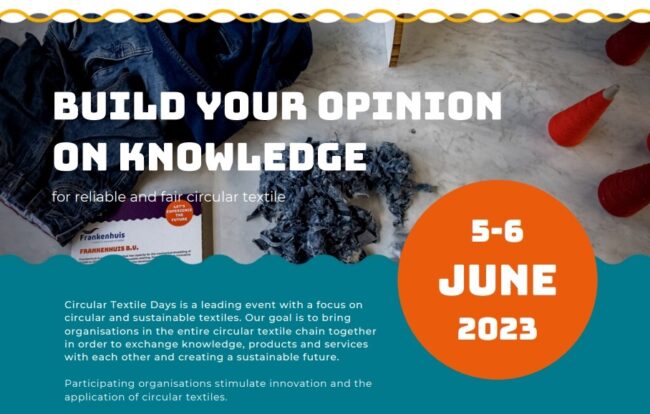
At the Dutch Circular Textile Days (June 5-6 last) a wide variety of concepts, materials and new projects were presented how circularity can be optimized. As an example the company Wear2go from Valkenswaard introduced a new smart sewing thread. After seventy seconds in a large microwave, the stitching loses its strength. Subsequently, the different materials of used garments can be easily separated. This and many other initiatives aim to make new steps towards an impressive higher circularity and sustainability of used textiles, in the years to come.
Will this new EU policy reduce the waste stream?
However there are also experts in the textile supply chain who believe that the waste stream will not quickly decrease due to the Extended Producers Responsibility for Textiles (EPR Textile). Some see this new legislation as a rather blunt instrument. Importers and producers pay the same contribution per kilo of textile, regardless of whether textile waste is difficult or easy to recycle.


