


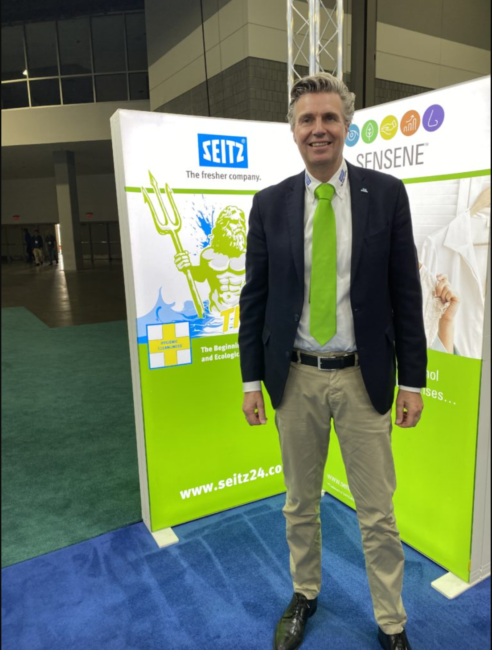


1. Can you please share with us your current position/job and profile of the organization you work for?
I am the owner of Seitz in Germany and have led the company for more than 30 years. Seitz is a leading global supplier of chemicals and solutions for the laundry and dry cleaning industry, with a particular strength in retail textile care.
2. In which countries and market sectors of Professional Textile Care did you work and did you gain experience?
As a supplier to the professional textile care industry, I have gained experience across many countries and sectors, primarily from the chemical and process perspective. This includes on-premise and off-premise laundries, hotels, nursing homes, fire brigades, and many other areas. Wherever professional textile care is carried out, we are involved as a supplier.
3. Could you please describe the most important characteristics and trends of the current PTC markets?
Overall, I see the PTC market as a growing market worldwide, driven by changing requirements and customer expectations. While the retail sector is declining or stabilising, there is strong growth in on-premise laundries and in medium-sized laundries serving increasing demand. This also includes uniforms and specialty cleaning. In particular, protective workwear is becoming more important, as it requires professional cleaning.
4. What do you see as the most important success factors for today’s PTC companies?
The most important factor is a strong customer-oriented mindset. This means understanding customer needs, knowing your customers well, and being able to deliver on your promises. This requires clear marketing, reliable processes, and consistent performance throughout the organisation.
5. What are your organization’s objectives and when would you consider your organization to be successful?
Our objective is very clear: we want to be the leading supplier of cleaning chemicals while also providing our customers with the information they need to run their businesses successfully. I consider our company successful when we have satisfied, returning customers. If all parts of the organisation work together to meet customer expectations, then the organisation as a whole is successful.
6. What do you consider the most important future demands of clients in PTC markets?
Future demand will clearly focus on sustainability. This applies not only to chemicals but to the entire process. Customers expect textile care operations to be as environmentally friendly as possible, and this expectation is increasing across all PTC market segments.
7. What are key issues for PTC companies to fulfil future client and market demands?
Digitalisation is a key issue, as well as having skilled people. Companies need to balance physical operational work with digital process control. It is essential to know where garments are at each stage, when they will be delivered, and to provide transparency so customers feel confident and secure.
8. How important are sustainability and circularity for your current business performance, and what do you do to improve them?
Sustainability and circularity are core elements of our long-term vision. Our business model supports these principles, as professional cleaning extends the life of textiles and keeps them in use. We continuously improve our performance by reviewing production, logistics, and business processes, with the goal of reducing energy use and environmental impact.
9. Do you see sustainability as a driver for new business or mainly as a cost-saving factor?
I see sustainability primarily as a driver for new business. At the same time, when sustainability is understood as reducing environmental impact, it also becomes a factor for cost savings.
10. Do you see technical innovation as a key factor to enhance business performance?
Absolutely. As part of the textile care supply chain, it is essential to continuously improve services for customers. This includes exchanging more information with customers and gaining better insights into their processes. By doing so, we can help them optimise performance and avoid unnecessary waste of resources.
11. What do you see as the most important innovations in the near future?
In the near future, automation and digitalisation will be the most important innovations shaping our industry. These developments will also improve transparency, especially in logistics and transportation, which is increasingly important for customers.
12. What is your policy to adapt your business and service model to changing market demands?
Our policy is to focus 100% on changing market demands. This must not be a mere statement, but something that is deeply embedded in the company’s culture. Everyone in the organisation needs to drive this forward. With many technological developments happening simultaneously, our role is to identify the right solutions and bring them to market to support our customers during challenging times.
13. Do you see attractive opportunities for smaller PTC companies, and what do they need to be successful?
As businesses scale, processes become more standardised and rigid. Smaller companies can be successful by specialising in more individual services and serving smaller customers who cannot be addressed as effectively by large operators. Innovation, close customer relationships, and flexibility are key success factors for smaller companies.
14. How can the PTC industry gain more market share compared to domestic washing?
This depends strongly on the market and region. In general, the service aspect is becoming increasingly important. People have less time and value convenience and quality. While washing at home may be easy, finishing textiles requires time and effort. Professional services can offer equal or better results while saving time and improving quality of life. Making people aware of these benefits is key.
15. What do you see as major long-term opportunities for the professional laundry and cleaning industry?
As populations age and people want to live independently in their homes for longer, professional laundry and cleaning services can play a major role. Pick-up and delivery services for household textiles can reduce daily burdens while supporting a clean, hygienic, and dignified life at home.
16. What do you see as major threats for the PTC industry in the coming years?
The major threat is the shortage of people. Populations are shrinking, while demand for professional textile care is increasing in several areas. Textile care is a labour-intensive industry, especially for complex or structured textiles, and skilled people are essential to manage these processes effectively.
17. What should (inter-)national industry associations do to support the PTC industry?
Associations should collect and share knowledge, present best practices, and provide standard operating procedures that companies can adopt. This helps avoid unnecessary duplication of effort and allows companies to implement proven solutions more efficiently.
18. What is your vision for the future of the industry?
I see a positive future with growth in many areas, even though some segments will remain challenging. Industry data shows long-term growth potential, but success will depend on maintaining cost-effectiveness while expanding services and capabilities.
19. What is your key message to your professional PTC colleagues?
My key message is simple: change is inevitable, so embrace it and move forward. Adaptability, technology, sustainability, and customer focus will define success now and in the future.


