


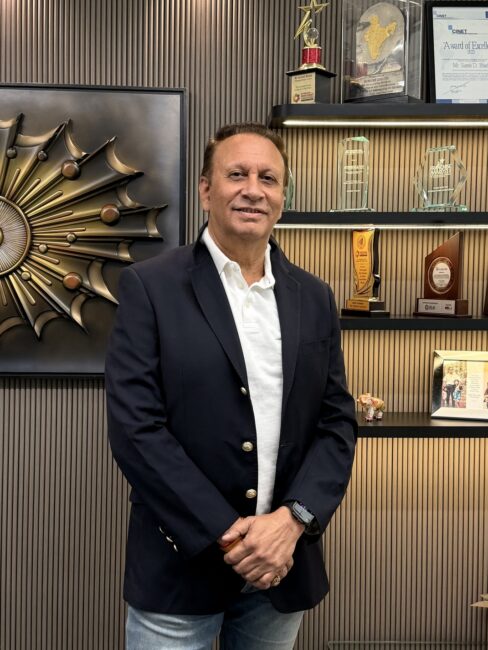


Suresh Bhatia – President – Dry Cleaners & Launderers Association of India (DLAI)
My view is that India offers enormous long-term potential for professional textile care, but it is important to understand one thing from the beginning: India is not one market. It is a country of around 1.4 billion people, with major differences between states in income, infrastructure, industrialisation, climate, legislation and consumer behaviour. The future opportunity is therefore substantial, but it requires patience, local knowledge and a long-term perspective.
I estimate that perhaps 20 to 30 percent of the population currently has sufficient purchasing power to consider professional textile care on a regular basis. Even that share represents a very large market by international standards. At the same time, commercial opportunity is not distributed evenly. States such as Maharashtra, Punjab, Karnataka, Tamil Nadu, Kerala, Delhi and Gujarat are among the markets where professional textile care can develop more quickly, while in less affluent regions opportunities may initially remain concentrated in major cities.
For me, the professionalisation of the industry depends on several factors developing together: formal recognition of the sector, modern regulation, skills, access to finance and changing customer behaviour. None of these issues can be solved in isolation. If regulation remains fragmented, if companies cannot finance technology or if trained manpower is unavailable, progress in one area will be slowed by weakness in another.
Formal recognition is particularly important because it affects how policymakers, financial institutions and other stakeholders view the sector. Environmental rules, wastewater requirements, licences and energy regulations can differ from one state to another, and some legislation affecting laundries and dry cleaners is very old. More modern and consistent standards would give companies greater confidence to invest.
Skills will be equally important. India does not necessarily lack people willing to work, but professional laundries increasingly need trained employees who understand machinery, automation, chemicals and technical processes. This is why DLAI is working with educational and government institutions, including the National Institute of Fashion Technology and textile-related universities, to explore recognized vocational courses, diplomas and higher-level qualifications.
I expect the market to grow on both the B2C and B2B sides. On the consumer side, professional textile care is still often used when a garment is visibly stained, damaged or difficult to process. Over time, I expect greater awareness of garment care, quality and sustainability to make professional services part of more regular consumer behaviour.
On the institutional side, the opportunity may be even more visible. India is continuing to develop hotels, healthcare facilities, aviation and railway infrastructure. All of these sectors generate large and recurring textile volumes. This creates a strong future for specialized industrial laundries that can provide capacity, hygiene and consistent service.
Technology will accelerate this transition, but it should not be confused with professionalisation itself. We already see cleaner and more professional retail locations and better branding. The challenge is that the production side does not always develop at the same speed. A modern shopfront can still be supported by traditional processing in the back end.
More professional machinery is entering the market, but investment decisions need technical knowledge. Operators must understand machinery, detergents, chemicals and process design so that they buy the right technology for the business. Industry organizations therefore have an important role in technical education and knowledge sharing.
I do not expect one single business model to dominate India. Large industrial operators will grow in metropolitan markets and serve hotels, hospitals and healthcare organizations. Medium-sized companies can find opportunities in shopping centres, sports clubs, entertainment and other institutional segments. Smaller companies can still build strong positions in B- and C-class cities where professionalisation is at an earlier stage but local volumes can still be substantial.
Sustainability and infrastructure will increasingly shape investment. Water treatment, energy supply, chemicals, logistics and working conditions are all connected. Better equipment, water and energy management, stronger standards and technical knowledge can reinforce one another. In India, I see sustainability as closely linked to professionalisation rather than as a separate theme.
The barriers are also clear: fragmented regulation, limited access to finance, shortages of trained manpower and a market that remains largely unorganized. When I started my business, I estimate that around 95 to 97 percent of the laundry sector was unorganized. Today I estimate that the figure may be around 80 to 85 percent. That shows progress, but also how much transformation is still possible.
International companies should not assume that a European or North American model can simply be copied into India. Climate, fabrics, garments, regulation and customer requirements vary strongly. My advice is to think in three-to-five-year investment periods and even longer when assessing the full opportunity. Local partnerships can provide essential market knowledge, while international partners can contribute technology, processes, investment and experience.
My vision for the next decade is of a much more visible and recognized Indian PTC industry, with stronger skills, clearer standards, better financing, modern production and a broader range of B2B and B2C services. The unorganized share of the market could fall significantly if regulation, education, finance, technology and cooperation continue to improve.
My key message is that India rewards commitment rather than short-term expectations. The potential is considerable, but companies need to understand regional differences, build local partnerships and invest with patience. For those that do, I believe the coming decade can open a much larger and more internationally connected professional textile care market.


