


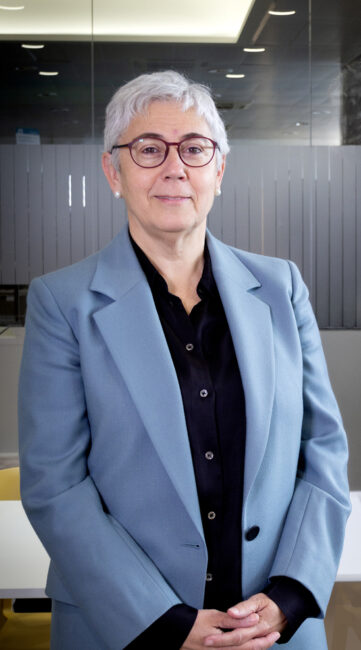


I am Chair and Chief Executive Officer of Girbau Group, a family-owned global manufacturer and supplier of comprehensive textile treatment solutions. Founded in 1920 in Vic, Catalonia – Spain, Girbau develops and supports equipment, systems and services for professional laundries worldwide. Our purpose is to be a reference in creating a positive impact on people and the planet.
In which countries and market sectors of Professional Textile Care have you worked and gained experience?
After thirteen years in banking, I joined Girbau and became Managing Director in 2008. Today, as Chair and CEO and a third-generation family member, I work with teams, customers, distributors and partners worldwide. Girbau serves around 140 countries through its distribution network and 15 sales and service subsidiaries. This has given me direct exposure to markets at very different stages of maturity and to applications including hospitality, healthcare, textile rental, industrial laundry, self-service and on-premise laundry. Above all, it has reinforced the importance of listening closely and translating different operational realities into relevant solutions and support.
Could you please describe the most important characteristics and trends of the current PTC markets in terms of customer and market demand?
Professional textile care is becoming more demanding and more diverse. Customers expect consistent hygiene and quality, reliable operations, traceability and faster response, while facing labour shortages, volatile resource costs, regulation and margin pressure. Customers increasingly evaluate not only the performance of individual machines, but the value delivered by the complete solution that simplify work and improve total cost of ownership.
The balance differs by segment and market, but the common expectation is clear: we, as suppliers, must understand the customer’s business, combine equipment with service and expertise, and demonstrate progress through measurable results rather than broad claims.
What do you see as the most important success factors for today’s PTC companies?
Service quality comes first: delivering textiles on time and to the required hygiene and quality standards. Efficiency is equally important and depends on disciplined processes, reliable equipment, skilled people, strong maintenance and control of costs and productivity. Successful companies also understand their customers’ needs and use data, technology and expertise to improve operations and services. And finally I would add that successful companies are the ones that have an engaged team.
What are your organization’s objectives, and when would you consider your organization to be successful?
Girbau aims to create long-term value by helping customers achieve more efficient, sustainable and profitable operations. We do this through tailored solutions, lifecycle support and a commitment to evolve alongside our customers.
For us success combines sustainable growth and profitability with measurable customer satisfaction, , our people engagement, and carbon footprint reduction. Value creation should be for all our stakeholders.
What do you consider the most important future demands of clients in PTC markets?
Clients will require stable quality with fewer resources, less dependence on scarce labour and tighter control of operating costs. Automation will be particularly important for physically demanding tasks; Girbau’s SORTECH linen-sorting solution is one response. Customers will also expect flexibility, connectivity, traceability, actionable data and faster predictive service, together with implementation support, training and accountability throughout the lifecycle.
What are the key issues for PTC companies in fulfilling the future demands of clients and markets?
Clients will demand operational and service excellence, traceability and data. But this will not be enough. The values behind the brand matter more and more. It is not only what we do but how we do it. Of course, this concerns all the companies, not only the PTC companies.
How important are sustainability and circularity for your current business performance, and what are you doing to improve your performance as an organization?
Sustainability is key for Girbau. It is part of our DNA and our purpose. We have set up very ambitious goals regarding achieving neutrality in CO2 emissions in 2030. In fact, we are already neutral in scope 2 since last year and achieving our yearly objectives in scope 1. We truly believe we must act for our planet and at the same time we see that an efficient use of resources improves the bottom line of our businesses. Internally, we invest in solar energy, electric vehicles, upgraded heating and water recovery. As most of our impact comes from machines in use, we focus on lower consumption, resource recovery, durability and the laundry as an integrated system. To really place sustainability at the centre of our strategy we link part of variable remuneration of our teams to carbon-footprint reduction
Do you see sustainability as an important driver for new business or as a factor for saving costs?
It is both. Reducing water, energy, chemicals, rewash and textile damage lowers operating costs and enables adoption at scale. Sustainability can also strengthen customer propositions, support compliance and tenders, and enable services based on reuse, longer textile life and transparent performance. Sustainability and circularity generate new business models and new opportunities around reutilizing materials, manipulating textiles in the sorting or waste management, and many other.
Do you see technical innovation as a key factor in enhancing business performance, and what technologies are essential to provide sustainable and profitable PTC services in the future?
Yes, when technical innovation solves real operational problems. Priorities include efficient washing and drying, intelligent dosing, heat and water recovery, automation, connectivity, traceability, predictive maintenance and software that converts data into decisions. Artificial intelligence can accelerate optimisation and service when applied responsibly. New materials, washing requirements and robotics will also shape the sector. Value comes from combining technology, process knowledge and lifecycle support.
What do you see as the most important innovations of the near future, and how will they change the way the industry operates?
Smarter process control, load-based consumption, traceability, remote diagnostics, predictive service and integration between production and business management will improve consistency and move operations from reaction to prevention. Automation will reduce dependence on scarce labour and improve working conditions, while heat and water recovery and longer textile life will reduce resource use. Success will depend on usability, serviceability and a viable business case. Over time, these advances can support circular and regenerative models, but the immediate priority is to convert innovation into reliable improvements for customers and their teams.
How is Girbau adapting its business and service model to more customer- and IT-driven processing?
We are offering a complete value proposition for each market sector based on the connectivity of our equipment that is providing data to both our customers and to us. We are using this data to improve our products and our services and help our customers to be more efficient and having more information about their businesses.
As PTC companies increase in scale, will there still be attractive opportunities for smaller companies, and what will they need to succeed?
Yes. Smaller companies can compete through specialisation, proximity, agility and deep local knowledge. They need professional management, control of quality and costs, accessible digital capabilities, skilled people and dependable support. At this moment, the adoption of new technologies like AI will probably help small companies in their agility and service personalization to their customers.
How can the PTC industry gain market share in textile cleaning compared with domestic washing?
In our industry the sharing economy trend is visible in the development of vended laundries in many geographies.
We also see a clear trend in the residence market where apartments become smaller and smaller and some spaces are shared, like washers and dryers, to reduce the footprint. It is more sustainable to use shared professional equipment than having a washer and dryer in each apartment.
And finally, there are new business models appearing like the pick up and delivery service for laundry.
What do you see as the major long-term opportunities for the professional laundry and cleaning industry?
The industry can become a more essential partner in how organisations manage textiles. Demand for hygiene, traceability, convenience and resilient operations will remain, while pressure to reduce resource use and extend textile life will intensify. Opportunities include the adoption of new technologies, IA, robotization to make operations more efficient and improve customer services and develop new ones based on data and lifecycle. Circular textile models and systems that recover water, heat and materials will also bring opportunities to PTC industry.
What do you see as the major threats for the PTC industry in the coming years?
Scarcity of labour is already a main threat. Climate change can lead to periods of severe drought, and consequently, there may be a shortage of water. Margin pressure, volatile energy costs, regulatory complexity and underinvestment in ageing operations.
What should national and international industry associations do to support the PTC industry now and in the future?
From my point of view, the key role associations have is to create an ecosystem where collaboration to share knowledge and create alliances allow the actors of the laundry industry to anticipate, adapt and respond to the challenges of the future. Associations should also help to position the industry as a recognised contributor to sustainability and positive social impact.
What is your vision for the future of the industry?
I see a professional textile care industry that is more connected, efficient and accountable, but also more diverse. Technology will make performance more visible and processes more consistent, while people will remain essential for judgement, service and improvement. Our broader ambition should be to evolve from resource-intensive laundry towards regenerative laundry ecosystems that recover resources, extend textile life
and create a net positive impact on people and the planet. This will require innovation, collaboration and long-term commitment though the whole industry.
What is your key message to your professional PTC colleagues for now and for the future?
We all have the responsibility to transform our industry into a more sustainable one, creating value for our customers, our people, our society and our planet. It is collaborating and sharing along the whole value chain that we will succeed in this transformation. Our long-term view is key to achieving it.


