


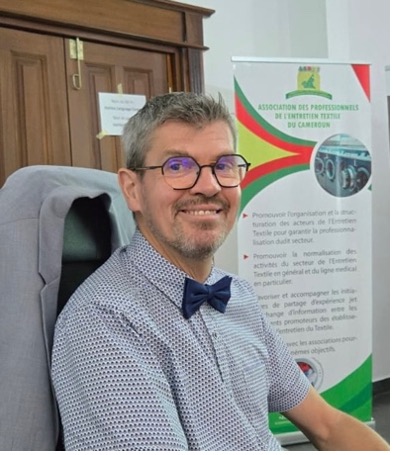


Interview Frederic Whecler, France
1. Can you please share with us your current position/job and profile of the organization you work for?
I am an independent consultant-trainer and the founder of TDU Expert®, a French firm specializing in professional textile care. I support organizations and businesses through audits, organizational consulting, hygiene standards, and microbiological risk management—specifically through the RABC / NF EN 14065 approach—as well as team training and coaching.
My work also includes supporting the creation or modernization of laundry facilities: sizing, equipment selection, workflow organization, and skill development. My approach is intentionally hands-on and operational: I start in the field, use simple data to provide objectivity, and then build an actionable, sustainable improvement plan.
2. In which countries and market sectors of Professional Textile Care did you work and did you gained experiences?
I began my career in the care of leather garments and rugs. I built the core of my expertise in France, working across several market segments: in-house laundries for healthcare and social care (nursing homes and clinics), industrial laundry and textile rental, as well as the hospitality and public sectors, where service and responsiveness are paramount.
I also have experience in retail dry cleaning and laundry, which has given me a deep understanding of local service logic, customer relations, and profitability in smaller business structures. Furthermore, I operate internationally through professional networks and collaborations with CINET, particularly in French-speaking Africa, with an approach focused on knowledge transfer, professionalization, and the structuring of training pathways.
3. Could you please describe the most important characteristics and trends of the current PTC markets in terms of customer/market demand characteristics and trends?
In France, client demand in the PTC (Professional Textile Care) sector is shifting significantly toward an expectation of proven reliability, rather than just a basic laundering service. Decision-makers now seek guarantees regarding service continuity, consistent quality, and the ability to handle peak volumes or unforeseen disruptions.
In the healthcare and social care sectors, this trend is particularly sharp: hygiene, risk management, and traceability have become core requirements. References to RABC (NF EN 14065) are increasingly structuring how needs are defined and how compliance is evaluated.
At the same time, clients expect providers to better manage ‘total cost of ownership.’ This means reducing re-wash rates, textile loss, non-compliance, and water and energy consumption. Finally, there is a growing demand for partnership: many clients are looking for a collaborator who can explain, train, secure, and improve operational practices, rather than a provider that simply executes tasks.
4. What do you see as the most important success factors for today’s PTC companies?
Today, the Professional Textile Care (PTC) companies succeeding in France are those that combine excellent operational mastery with a genuine service culture. Quality and productivity do not rely on equipment alone: they depend on organization, team stability, training, and management’s ability to enforce simple yet consistent standards.
Hygienic control and the capacity to provide evidence—through procedures, audits, and traceability—are becoming key competitive advantages, particularly in highly sensitive markets. Furthermore, data-driven management, even at a basic level, has become a deciding factor: a company achieves sustainable progress when it measures its volumes, re-wash rates, consumption levels, and downtime, addressing root causes rather than just symptoms.
In this context, the ongoing consolidation of the sector in France further reinforces the importance of industrial performance and differentiation through service quality.
5. What are your organization objectives and when would you consider your organization to be successful?
TDU Expert®’s objective is to help organizations secure their practices and improve overall performance through a results-oriented approach. In concrete terms, I strive to advance service reliability, hygienic control, organizational efficiency, and the professional development of both teams and management.
I consider objectives met only when practices are consistently applied over the long term—when teams truly understand what they are doing and why—and when results can be validated by simple indicators: a decrease in non-compliance and re-work, improved turnaround times, stable quality, reduced consumption, and better breakdown management.
Bringing meaning to our work and promoting the value of our profession is a major source of motivation for me.
6. What do you consider the most important future demands of clients in PTC markets?
Future client demands in France will center on transparency, traceability, and resource efficiency, all while maintaining intense pressure on service levels. Clients will demand more evidence: proof of hygienic control, proof of quality, proof of environmental performance, and more frequent reporting.
Expectations for footprint reduction—covering energy, water, chemicals, logistics, and textile lifespan—will continue to rise, particularly as these criteria increasingly become mandatory in public procurement and corporate social responsibility (CSR) policies for major stakeholders.
Finally, I believe that resilience will become an explicit expectation: the ability to maintain service despite labor shortages, rising energy costs, or technical incidents will be a decisive factor in choosing a provider.
7. What are key issues for the PTC companies to fulfill future demands of clients and PTC markets?
To meet these demands, PTC companies must overcome a challenge that is as much human as it is industrial. The first priority will be the ability to recruit, stabilize, and train, as performance and hygiene rely primarily on skills and operational discipline.
The second challenge involves intelligent investment: modernizing equipment where it adds value, strengthening maintenance, and scaling production lines to actual volumes while avoiding over-investment that compromises profitability.
The third pillar is the implementation of simple, consistent steering: measuring, analyzing, deciding, and staying the course. Finally, digitalization must be useful and pragmatic: it should support traceability, production tracking, and client relations without replacing hands-on management or the mastery of core technical tasks.
8. How important is sustainability / circularity for your current business performance and what do you do to improve your performance as an organization?
Sustainability has become a major priority in France, driven by both commercial and economic imperatives. From a commercial standpoint, it is now a key selection criterion, particularly in public procurement and for corporate groups with strong CSR commitments. From an economic standpoint, sustainability is directly linked to performance: optimizing water, energy, chemical usage, and textile lifespan immediately improves the total cost of ownership and service stability.
In my consulting missions, I focus on highly practical levers: reducing re-wash rates through better sorting and workflow organization, optimizing wash loads and parameters, strengthening preventive maintenance, and—crucially—training teams so that resource efficiency becomes a daily habit rather than just a slogan.
It is often in the details—sorting, loading, and process discipline—where true, sustainable results are achieved.
9. Do you see sustainability as an important driver for (new) business or as a factor for saving costs?
I view sustainability as both a cost-saver and a growth driver, though on different timelines. In the short term, it acts as a powerful lever for cost reduction, as energy, water, chemical inputs, and textile wear-and-tear weigh heavily on profitability.
In the medium term, it becomes a true engine for growth, as decision-makers increasingly demand formal commitments, evidence, and clear roadmaps. The companies that succeed won’t be those that communicate the loudest, but those that can demonstrate—backed by hard data—that they deliver sustainable performance without compromising on quality or service.
10. Do you see technical innovation as a key factor to enhance your business performance, and what technologies are essential to provide sustainable and profitable PTC services in the future?
Yes, technological innovation is a key factor, provided it serves an already well-managed organization. The technologies that will matter most are those that enhance control and security: leveraging machine and production data, dosing and parameter monitoring, supervision, more predictive maintenance, and energy efficiency solutions.
In France, the energy issue is particularly structural, as there are significant opportunities for improvement in areas such as drying and finishing. To my mind, useful innovation is that which simultaneously improves quality, safety, productivity, and resource efficiency, without adding unnecessary complexity to the teams’ daily work.
11. What do you see as the most important innovations of the (near) future and how do you believe these innovations will change the way the industry operates?
In the short term, the most transformative shift will likely be the smarter use of data: gaining a better understanding of the root causes of non-compliance, stabilizing quality, anticipating breakdowns, and reducing consumption.
Another breakthrough—more gradual but very real—is the arrival of more accessible and modular automation. This will allow mid-sized facilities to improve productivity without necessarily committing to massive, high-risk projects.
Finally, I believe the service model itself is evolving: clients will increasingly expect a ‘complete solution’—encompassing traceability, reporting, compliance, and ongoing support—rather than just the physical processing of textiles.
12. According to many publications, a transformation of the PTC industry towards more customer and IT driven processing, is seen as essential to be successful in the future. What is your policy to adapt your business/service model to changing market demands?
I am convinced that digital transformation is necessary, but I advocate for a pragmatic approach. The priority must be to implement tools that truly serve decision-making and provide proof: production monitoring, traceability, service indicators, and more fluid communication with the client.
In my approach, digital tools must reinforce field operations: they should make deviations visible, assist in decision-making, and facilitate the maintenance of standards. A successful digital transformation is not one that multiplies the number of tools, but one that simplifies management and makes performance and quality easier to maintain.
13. We have seen an enormous increase in scale of operation of PTC companies. Do you see there will be attractive opportunities also for the more smaller companies and what is needed for small companies to be successful?
Despite the increasing operational scale of major players, I believe that real opportunities still exist for smaller structures in France. They can succeed if they embrace their inherent strengths: proximity, responsiveness, personalized customer service, niche specialization, and the ability to build long-term relationships based on trust.
The key area for vigilance is that they must be exceptionally solid in terms of organization and quality, as they have less room to absorb unforeseen disruptions. This requires investing in training, monitoring a few key indicators, and sometimes joining forces or pooling resources to secure certain functions. The network of dry cleaners and retail laundries perfectly illustrates this potential, as well as the ongoing challenges of business succession, modernization, and the renewal of skills.
14. How do you feel the PTC industry can take more market share in the markets of textile cleaning, compared to domestic washing?
To gain market share against home laundering, the PTC (Professional Textile Care) sector must better communicate its value proposition. It is not just about ‘washing’; it is about providing a service that saves time, protects textiles, handles complex items, and guarantees consistent quality while conserving the planet’s resources.
There is also the critical factor of customer experience: collection, tracking, information, and simplicity. The more seamless and transparent the service becomes, the more the comparison with home laundering will be based on actual benefits rather than just price.
15. What do you see as major opportunities for the professional laundry and cleaning industry for the longer term future?
In the long term, the French PTC industry holds solid opportunities, particularly as needs in the healthcare and social care sectors continue to grow, demanding services that are both reliable and auditable. Increasing requirements for sustainability and transparency will also drive decision-makers to seek partners capable of providing concrete evidence and clear improvement roadmaps.
Ultimately, I believe the industry can create more value by positioning itself as a comprehensive textile function manager: from selecting textiles and optimizing their lifespan to reducing losses and integrating the environmental dimension directly into operational performance.
16. What do you see as major threats for the PTC industry in the coming years?
The primary threats in France are labor shortages, price pressure, and the volatility of energy and input costs. Added to this are the risks associated with under-investment and delayed modernization, which jeopardize service continuity and quality.
Finally, sector consolidation may create vulnerabilities for certain players if it accelerates price-based competition at the expense of quality and skills development.
17. What would you say industry (inter-)national associations should do to support the PTC industry professionally, now and in the future?
Professional associations have a pivotal role to play in structuring and securing the sector. They can provide support by developing clear standards and benchmarks, enhancing the attractiveness of industry careers, supporting training and skill development, and facilitating the exchange of best practices across borders and market segments.
They also serve a critical representative function: providing a credible collective voice to institutions, clients, and partners. Their mission is to translate major trends—such as digitalization, CSR, and quality standards—into realistic operational actions, while showcasing the value of a profession that remains largely misunderstood by the general public.
18. What is your vision on the future perspective of the industry?
I am generally optimistic about the future of PTC, provided the industry fully embraces its transformation. The future will not be driven by technology alone: it will be built on organizations that are more data-driven, transparent, and responsible, but also more attentive to skills and local, hands-on management.
Value will flow to those who can prove their performance, maintain a reliable service, and integrate sustainability as a natural component of quality.
19. What is your key-message to your professional PTC colleagues for now and in the future?
My primary message to fellow PTC professionals is to stop presenting ourselves as mere laundry operators, but rather as specialists in reliability, hygiene control, performance, and sustainability. While technology and investment are important, the true differentiator lies in competence, rigor, and the ability to uphold standards over time.
My experience confirms one thing: the most solid transformations do not come from a new machine, but from a team that understands, measures, and masters the process. The future of Professional Textile Care is technical expertise driven by human excellence.


