


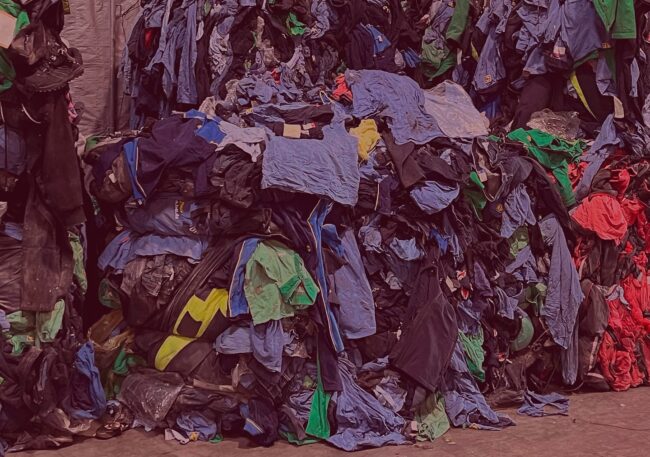


The textile industry is one of the most resource-intensive sectors and generates significant amounts of waste and emissions. In 2020 alone, around 6.95 million tonnes of textile waste were produced in the EU. Worldwide, 92 million tonnes of textile waste finish in landfills. For that reason, the EU’s Circular Economy Strategy advocates circular processes in the textile sector.
Recently, the Fraunhofer Institute for Applied Polymer Research IAP at Potsdam Science Park, Beneficial Design Institute GmbH and matterr GmbH (formerly RITTEC 8.0 Umwelttechnik GmbH) investigated in a joint feasibility study, how polyester-containing waste textiles can be converted into the bioplastic polyhydroxybutyrate (PHB). PHB is a bioplastic that is completely biodegradable, resorbable and biocompatible. The policy paper translates the results into concrete recommendations for political decision-makers in the city of Brandenburg It comprises six key recommendations.
1. Promote start-ups and regional textile biorefineries for efficient resource use.
2. Support research and development of new recycling technologies for old textiles.
3. Establish a competence cluster for data-driven textile recycling.
4. Support digital data collection along the entire value chain.
5. Qualify companies for the upcoming Ecodesign Directive 2026
6. Integrate local companies into European value chains as part of the EU initiative “Regional Innovation Valleys for Circular Economy”.
The initiative not only provides a multi-stage action plan to establish a circular textile economy in this region, but could also be worthwhile studying on a larger scale.


