


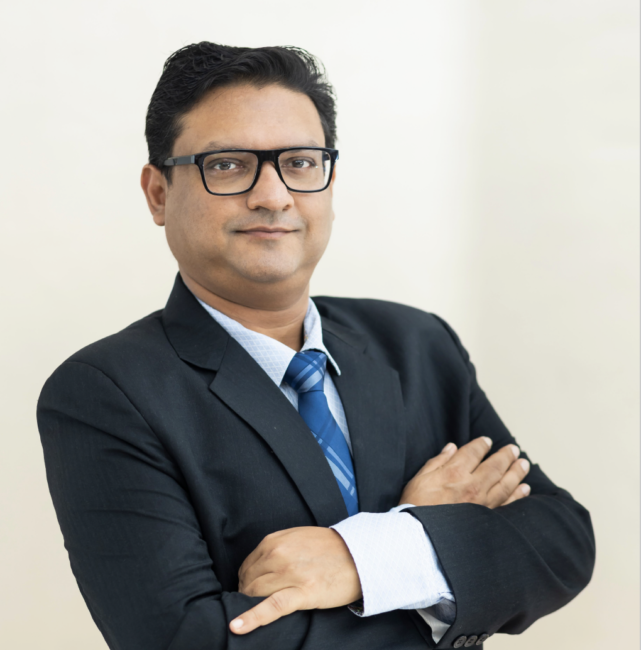


A Visionary Approach to the Indian Textile and Laundry Industry: Interview with Anup Poddar, Vice president of CINET & DLAI
In this interview, we explore the remarkable journey of Anup Poddar, a leading figure in the Indian laundry and textile care industry. As a Vice – President of the International Committee of professional Textilecare CINET, Sr. Vice – President of the Drycleaning & Laundry Association India (DLAI) and a key executive at BeePee Group, Poddar shares his insights on the evolution of India’s laundry sector, international cooperation, and what to expect from the upcoming World Congress in Frankfurt.
Personal and Company Background
Anup Poddar’s journey into the textile and laundry care industry began at the early age of 16 when he joined the family company BeePee Group, a 132-year-old textile company and started hospitality linen division. Under his leadership, the company ventured into the laundry industry around 2015, responding to the growing needs of hospitality clients facing linen quality issues.
“At the time,” Poddar explains, “there was always a blame game between laundry operators and linen suppliers, each blaming the other for quality issues. To address this, we created a laboratory laundry inside a five-star hotel to test and ensure the quality of our linens.”
This innovative approach laid the groundwork for BeePee Group to become the first company in India to introduce the concept of linen rental, a business model widely accepted in Europe and the US, but relatively unknown in India. Despite initial resistance, the model took off, and BeePee Group began rapid expansion in the hospitality and healthcare sectors.
The Indian Laundry Market: A Rapid Evolution
India’s economic growth has significantly altered consumer behavior over the last decade. According to Poddar, from 2015 to 2020, the country saw increased purchasing power, creating more demand for branded and higher-quality garments.
“As consumers spend more on their clothes, the need for professional fabric care has risen,” says Poddar. “People are willing to pay for quality laundry services to ensure the longevity of their expensive items. This has led to a retail laundry boom in India.”
On the business-to-business (B2B) side, the expansion of the hotel industry in India has been tremendous. “We went from 220 five-star hotels pre-COVID to over 1,000 today, with major brands like Accor, Taj, and Marriott expanding aggressively,” he notes. “Hotels are realizing that investing in laundry infrastructure is not cost-effective, and outsourcing laundry services is a better alternative.”
The healthcare sector also represents a significant market for BeePee Group, particularly with the growth of hospital laundry services. During the COVID-19 pandemic, BeePee Group launched new services, including charitable laundry services for frontline workers, which further solidified their role in the healthcare industry.
International Cooperation and Learning
Poddar emphasizes that international cooperation has played a vital role in shaping the Indian laundry industry. Through partnerships in the UK and the US, BeePee Group has gained valuable insights into advanced laundry practices. He believes that India still has much to learn from international markets, especially when it comes to automation and technology.
“Automation is the future,” Poddar states. “India is still labor-intensive, but productivity is much lower than in developed markets. In Europe, one person manages ten tables in a restaurant, while in India, you might need ten people. The same applies to laundry. Automation, such as towel folders and stackers, is something Indian laundries must adopt.”
He sees great potential in artificial intelligence (AI) and robotics for optimizing laundry operations, something that is still in its infancy in India. Nevertheless, he points out that Indian laundries have begun adopting modern technologies like auto-dispensing stations and that the industry is moving in the right direction.
Sustainability: A Key Driver for Future Growth
Globally, the professional textile care industry is increasingly focused on sustainability, and Poddar believes this will be a major driver for growth in India as well.
“Water recycling, energy savings, and reducing carbon footprints are essential for the survival of any laundry business,” Poddar asserts. He cites the importance of sustainability in meeting government policies and staying competitive in the international market.
However, he admits that India has a long way to go, especially in sectors like healthcare, where improper washing practices contribute to hospital-acquired infections. “Around 92% of hospital infections in India are related to linen care, highlighting the urgent need for improvement in hospital laundry standards,” he says.
Education and Training: The Missing Link
One of the areas where India still lags behind is education and training in professional textile care. “We lack industry-specific education programs,” Poddar points out. “India could become a global hub for trained manpower in laundry care, but we need to develop standardized training programs to match international levels.”
Poddar believes that the industry must invest in human capital to bridge this gap. With the right education and training initiatives, Indian laundry professionals could not only improve domestic operations but also compete on the global stage.
Expectations for the Frankfurt Event
Looking ahead to the CINET World Congress in Frankfurt, Poddar is eager to engage with industry peers and exchange ideas. “The event offers a unique opportunity to network with like-minded individuals and learn about the latest industry innovations,” he says.
For Poddar, the key takeaway from such events is understanding how different companies approach similar challenges. “Everyone has their own system for running a successful laundry business. I’m looking forward to discovering best practices from around the world and seeing how we can apply them back home in India.”
Conclusion
Anup Poddar’s journey from a family-run textile business to a leader in India’s burgeoning laundry industry is a testament to his innovative mindset and willingness to embrace change. As India continues to evolve economically, the laundry and textile care sector is poised for substantial growth, driven by automation, sustainability, and international cooperation.
Through his work with BeePee Group and his role in DLAI, Poddar is helping shape the future of professional textile care in India, ensuring that the country remains competitive on the global stage. As he prepares for the World Congress in Frankfurt, his focus is clear: learn, adapt, and grow.


