


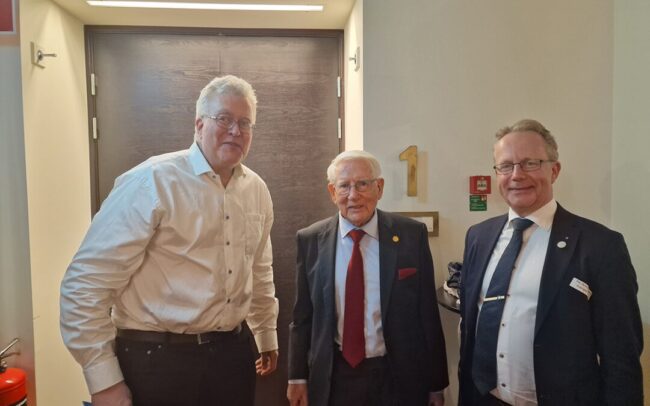


(Photo: Riksdag member Per-Arne Håkansson and our Daniel Kärrholt accompanied Nestor Thage G Peterson out to the elevator and waiting car. Per-Arne told us that he had just turned 60 and Thage, who turns 90 in September, quickly responded: “60 – these were the days.” Photo: Kalle-Ville Lampi)
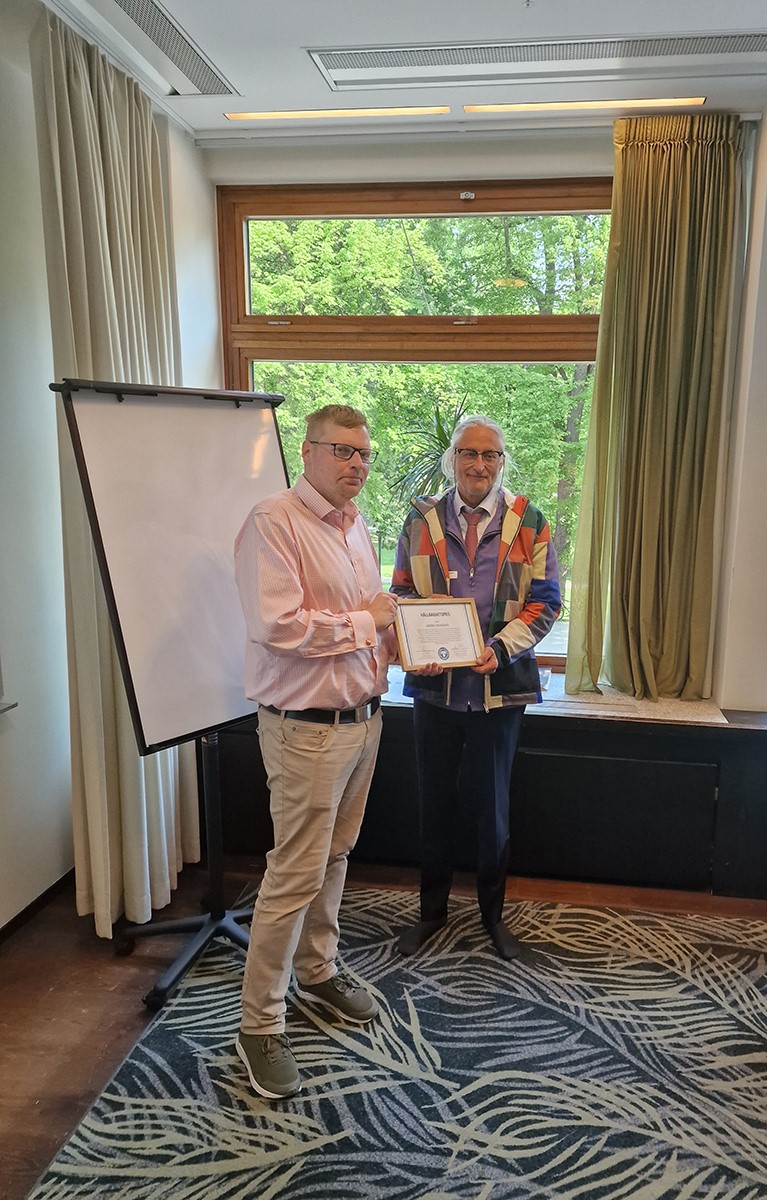
This time the annual meeting had been located to classic Anglais at Humlegården in the middle of Stockholm city. On this sunny Thursday morning, the 25th of the month at the party quarters around Stureplan, there were probably one or two were humming on the artist Magnus Uggla´s “king, king in the bar”.In the hotel , however, other top food and drink was provided – coffees and lunch of the highest class. Outgoing chairman Jan Kluge welcomed everyone and especially our opening speaker Robert Johansson, personnel regional councilor Region Stockholm. Robert gave an inspiring talk about everyone who moved to Stockholm to contribute their talents. In conclusion, Robert had the honor of presenting the Swedish Textile Service Association’s sustainability award to Anders Thorgaard, entrepreneur, visionary and owner of the laundry and textile service group DFD/Textilia.
He received the Sustainability Award
Anders Thorgaard has taken the initiative to be able to upcycle textiles into new products on an industrial scale instead of burning or throwing away discarded textiles. This saves the environment. The concept, which goes by the name upcy, means that discarded textiles become raw material in newly designed products. For example, old duvets become new trendy jackets and worn-out tablecloths from the gourmet restaurant become great chef’s coats. Customers can order and take the upcycled textiles into their businesses and contribute to a circular economy. This was also shown in the film that concluded Anders’ acceptance speech.
(Photo: Daniel Karrholt)
Michael Sandin: new chairman
At the association’s annual meeting the association elected Michael Sandin, (58 years old) as the new chairman. Sveriges Tvätteriförbund thanks Jan Kluge for his efforts during seven good years.
This is how we make ourselves attractive
The morning then featured three speakers – Martin Stenfors, COO Renewcell, Martin Löfgren, Director Group Procurement Scandic Hotels and Mikael Jansson, Managing Director ManpowerGroup. Martin Stenfors explained that Renewcell is scaling up feedstock sourcing to match the increased production capacity in the company. By 2025 Renewcell will annually produce 250.000 metric tonnes of dissolving pulp from post consumer and post industrial textile waste and will be sourcing equally large amounts of textile waste feedstock. Martin Löfgren presented based on the title – “How are we attractive and take responsibility as a customer” that Scandic, by virtue of its 280 hotels with 58000 rooms in six countries, is an important part in making a sustainability mark in the hospitality industry. With the new Med Scandic Go concept, Scandic’s growth rate is estimated to be able to increase by 1000-1500 rooms annually. Mikael Jansson with seven years at the then Tvättman Textil Service highlighted the importance of being an attractive employer both today and tomorrow. A clear trend is the difficulty in finding the right skills – three out of four Swedish employers cannot find the right person for the job. At the top of the list are IT and data and of the soft wishes reliability.
Comprehensive program
The rest of the afternoon Anne-Charlotte Hanning, Senior project leader and researcher Materials and Production, RISE, presented the project “Upstream cleaning at industrial laundry with the intention of minimizing the release of microplastics and effects at the water and sewage plant”, a project, , in cooperation among others with Textilia, Christeyns and Sveriges Tvätteriförbund
Ulrike Ryll, project manager SIS for the committee for Medical Textiles (SIS/TK 332) and Agneta Gunillasson, project manager SIS/TK, for Surgical Textiles (SIS/TK 333) also spoke. Ulrike and Agneta gave a welcome insight into the work around show caseardization and revision of the Textilhandboken. A very interesting discussion followed and led to a deepened cooperation with STSA and international channels.


