


(Photo: Guidance & Instruction at company level)
CCD makes it measurable
Laundries are increasingly asked whether the delivered textiles are indeed hygienically clean. After all, this is difficult to determine without measurements. In itself a simple, but important question, but also a question, which is often not easy to answer. With the help of CCD, delivering really hygienically clean linen is a simple and straightforward service. How they assist with this became clear when we recently spent a day with Anthony Hendriks. Anthony is the owner of CCD and spends many hours as a consultant and trainer in laundries.
A reliable hygienic result starts with a valid washing program. “For proper disinfection, it is important that the textiles are visually clean,” Anthony explains on our way to the customer. With the ever-rising costs of water, energy, and chemicals, it’s also important to ensure that things aren’t done unnecessarily well. “I fully agree,” says Anthony and he starts explaining about the various ways CCD helps to determine the actual result of the washing process in a simple and objective manner.
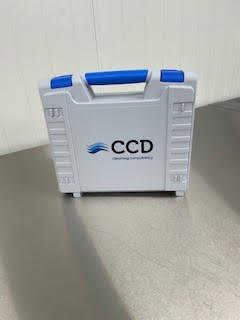

Measuring of stain removal
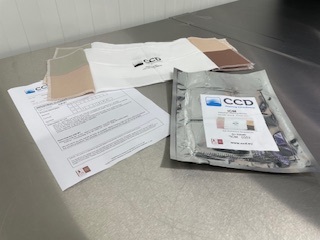
“To measure the stain removal of industrial washing programs, the Industrial Cleaning Monitor (ICM) has been developed. By using different types of stains, the ICM gives a good insight into the performance of the different phases of the washing program,” Anthony explains. “Using the ICM in the laundry is very easy.” Meanwhile Anthony shows how easy it really is. “After receipt of the washed ICM, it’s assessed
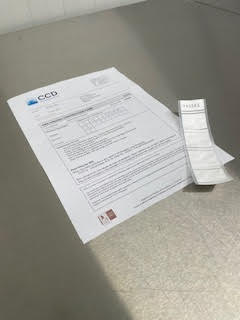
by us. The laundry receives a clear report about the performance of the washing program. Because this performance is compared to a standardized reference process, it’s expressed as a %. This allows us to show the performance of the current prewash, main wash and bleaching phase and also allows the laundry to compare the results with previous measurements or those of other washing machines or
facilities.”

Disinfection at lower temperatures
Thanks to the innovative chemistry of various detergent suppliers, laundries are able to disinfect the linen effectively at lower temperatures. Thermal disinfection has been replaced by chemo/thermal disinfection or fully chemical disinfection. This leads to lower energy consumption and often shorter washing programs. However, the level of disinfection can no longer be determined by measuring the temperature. “Therefore CCD has developed the DES (disinfection) controller”, Anthony explains. As he shows how easy it is, he speaks further, “This DES controller is washed with the linen. The DES controller is a bio-indicator containing various amounts of bacteria, protected by a membrane. Therefore the test germs do not rinse off, while chemicals, water and heat pass through the membrane without a problem. And, very important, laundry employees cannot in any way come into contact with the test germs.” After
the DES-controller is analyzed in the CCD laboratory, a concise report indicates the level of disinfection. The performance of the washing program can thus be easily demonstrated and compared with the upfront agreed level of disinfection.
Self-monitoring
Ensuring a hygienically clean performance does not stop with a proven washing program. CCD specialists regularly inspect laundries whether the clean textiles are free from pathogens and sufficiently low in the total amount of bacteria. In addition, they train laundry staff to monitor hygiene properly by using CCD’s test materials. This training can be provided either on site or digitally.
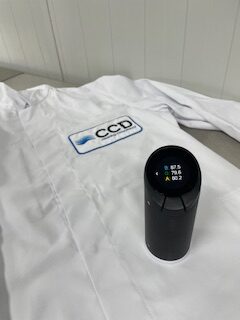
Measuring whiteness
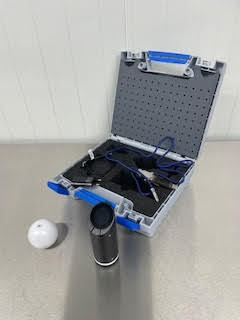
In addition to being stain-free and hygienically clean, also the whiteness of the washed textiles often is an important performance indicator. For (the customers of) a laundry, it is important to know if the whiteness of the textile does not decrease disproportionately quickly. Anthony explains that aging (deposition of hardness or dirt particles), cause the brightness to decrease. “The whiteness decreases” he clarifies. “However, since the degree of whiteness cannot be objectively determined with the unassisted eye and is difficult to describe, CCD has developed a tint meter. We call this our TRA. This allows the whiteness of the linen in the laundry to be objectively measured. Measured values can be compared with the goal or previous measurements. In this way the development of whiteness over time can be tracked. This is called a trend.” Anthony demonstrates us how laundries can perform these measurements themselves as often as desired using the TRA.
Measurable hygienically clean is easy and straightforward. For yourself and for your customer.
Cleaning Consultancy Delft B.V. (CCD) has been active for over 30 years as an independent consulting firm for the industrial laundry industry. CCD’s specialists provide international advice on various topics related to industrial cleaning, ranging from technology to quality, and from hygiene to environmental impact. To assess the performance of a washing process, to help the industry objectively, CCD has developed various measuring instruments, for example to measure soil removal, disinfection, whiteness, shrink and textile damage.


