





Introduction:
Food production becomes a rather complex industry, in which unhygienic work conditions and risks of contamination are a continuous plague. Food processing, preparation and manufacturing requires very high levels of hygiene in order to avoid that unsafe food may threaten public health. Moreover it is essential to understand that good hygiene practise has an important effect on food shelf life.
Good Manufacturing Practise [GMP] and HACCP define critical areas in the food processing chain that have a significant impact on the hygienic quality of the products produced. Serious health incidents in the past have forced all manufacturers to make hygiene priority number one in their facilities.
And this is why several global players in the food industry – in co-operation with representatives out of the laundry industry, have defined hygiene-standards. Standards that are specifically relevant for garments that are used in the critical areas of the food factories, such as dairies.
Human beings are THE source of contamination in a dairy plant, affecting safety of the final product. Proper design of hygiene clothing is essential to prevent the skin from coming into contact with the products.
Example : Listeria Monocytogenes

Listeria monocytogenes is the species of pathogenic bacteria that causes the infection listeriosis. It can grow and reproduce inside the host’s cells and is one of the most virulent foodborne pathogens: 20 to 30% of foodborne listeriosis infections in high-risk individuals may be fatal. Listeriosis mortality rates are higher in the EU and USA than for any of the other foodborne pathogen.
Listeria food poisoning is hold to be responsible for approximately 1600 illnesses and 260 deaths in one year in the USA alone. And also represents one third of all food poisoning cases in Europe. This pathogenic bacterium can be found in: Dairy products including soft cheeses. But also in raw and cooked poultry, raw meats, raw and smoked fish.
Its ability to grow at temperatures as low as 0 °C permits multiplication at typical refrigeration temperatures, greatly increasing its ability to evade control in human food.
Focus for work wear laundries
Special attention should be given to those work wear classifications that come into contact with food. The Listeria story [see above] already gives an indication which food production facilities belong to the high risk factories.
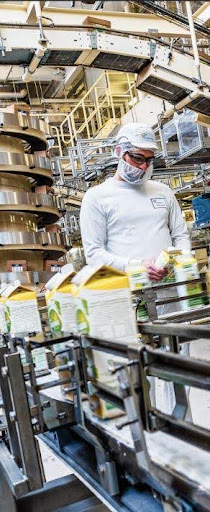
But Listeria is not the only reason for concern. Think of Salmonella, Clostridium Botulinum [in fish] and Noro virus in raw oysters. As well as moulds such as Aspergillus Niger in bakeries.
The implications of all of this is that work wear from dairy, fish, meat, and poultry should be washed as heavy soiled linen that needs maximum attention in terms of disinfection. Some laundry groups have specialised in this bracket of the laundry market and created a dedicated high care department / production line within the laundry building.
Washing garments for the food industry requires a well trained staff and clearly defined procedures and processing. In a Masterclass [see chapter 7] we also deal with specific workwear classifications: Fire brigade, the oil and chemical industry, metal industry [Safety !] , Clean room garments for the Pharmaceutical Industry and the Electronic Industry.
FOOT NOTE:
A serious contamination with the bacterium Cronobacter Sakazakii closed down the largest baby milk producing factories in the USA.
This event has been a warning for the complete dairy industry and has globally resulted in defined guidelines for disinfection – including the washing of work wear.


