


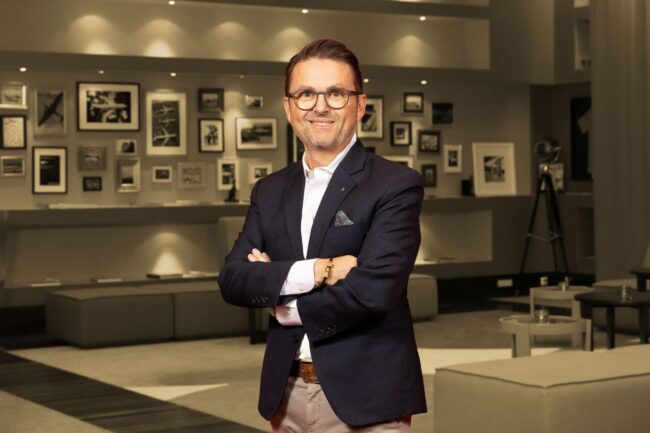


Martin Rauch – JENSEN-GROUP
My vision for the industrial laundry is a workplace in which technology takes over much of the repetitive and physically demanding production work, while people move into safer, healthier and more valuable roles. I believe we are entering a new era in which robotics, artificial intelligence and integrated digital systems will fundamentally change how laundries are designed and operated.
At JENSEN, we have already seen that this is not a distant concept. Automation of the soiled side with robotics and AI, developed together with our partner Inwatec, has become a proven solution in laundries in Europe, the United States, Australia and other markets. We also see automation expanding into finishing and logistics. The BLIZZ robot can feed different sizes of towels into the Butterfly terry folder without human intervention. GREIT provides modular stack storage for flatwork, and Jenway handles transport and sorting in the later stages of the automated process.
For me, the importance of these developments is larger than labour reduction alone. Automation can increase production speed, improve consistency, reduce human error and extend the life of textiles and equipment. It can also create a much more attractive workplace. If robots take over strenuous and monotonous tasks, employees can focus on process control, customer-related responsibilities, technology and problem-solving. This is one of the ways our industry can become more attractive to a younger generation.
I expect customer requirements to continue moving in three directions at once: higher quality, faster processing and lower cost. The only sustainable way to meet all three is to optimize the complete process. Automated sorting, washing, finishing and logistics allow higher throughput with fewer manual handovers. Data and the Internet of Things can then add another layer by continuously showing where performance can be improved.
Sustainability is part of the same logic. With our CleanTech concept, which dates back to 2008, we have focused on reducing water and energy consumption while improving competitiveness. Efficient machinery lowers resource use and operating cost simultaneously. Gotli Labs, with experts from JENSEN and ABS, strengthens this data-driven development by looking at process optimization, turnaround time, quality and cost.
Different market sectors will continue to need different solutions. Healthcare laundries place the highest priority on hygiene and precise handling of medical textiles. Hospitality needs speed, high volumes and excellent finishing. Workwear operations require durability and consistent garment quality. The principles of automation and sustainability are common, but the right system has to be adapted to the process and the customer segment.
I also believe automation is becoming increasingly relevant to smaller companies. The future is not only for the largest laundries. Whether a plant processes around 10, 30 or 100 tons per day, modular systems can be selected around the actual process. Foreign-object detection, automated separating, classifying and sorting can be introduced step by step rather than only as one enormous project. Modular and scalable systems allow companies processing different volumes to automate specific parts of the operation. The investment decision should always be based on volume, workflow complexity, quality requirements, flexibility and financial objectives. In some businesses, a full integrated solution makes sense; in others, targeted automation creates the best return.
Robotics will become standard in more areas. I can imagine a future in which robots in the reception area are as normal as tunnel washers or finishing lines are today. AI will accelerate this development. A system such as the HEIMDAL.Camera shows how visual information can be used for automated sorting of unmarked garments. When a mental task can be performed quickly by a person and sufficient data exists, there is a good chance that AI can support or automate it.
At the same time, replacing humans is not simple. The combination of body and brain is extremely sophisticated. Robots do what they are taught to do, which means we still need the best people to design, train and supervise intelligent systems. This is why I see the future as cooperation between people and machines, not simply substitution.
Robotization also contributes to sustainability and safety in practical ways. Foreign-object detection and X-ray technology can prevent pens, needles, scalpels and other objects from entering the process. That protects employees, prevents damage to machinery and extends textile life. Sustainability also includes the social side: creating safer and more attractive work and helping customers achieve their ESG objectives.
The maintenance model will evolve as well. Robotics does not necessarily mean dramatically more maintenance, but it does require stronger technical competence. Remote service and digital support will become increasingly important alongside predictive maintenance and smart diagnostics, helping laundries solve routine issues faster and reserve specialist support for the more complex tasks. Predictive maintenance, real-time monitoring, smart diagnostics and remote service can reduce downtime and guide operators through routine tasks. Training will therefore be an essential part of every automation strategy.
Looking further ahead, my vision is of Laundry 2.0: an industrial laundry that is autonomous in many production steps, digital, resource-efficient and attractive as a workplace. The most successful companies will not automate individual machines in isolation. They will connect sorting, washing, finishing, transport, data and service into one intelligent flow.
We are still at the beginning of this development. My key message is to see robotics and AI not simply as a way to remove labour, but as tools to redesign the laundry. If we use technology to make work smarter, safer, more sustainable and more productive, we can create an industry that attracts talent and delivers much greater value to customers.


