


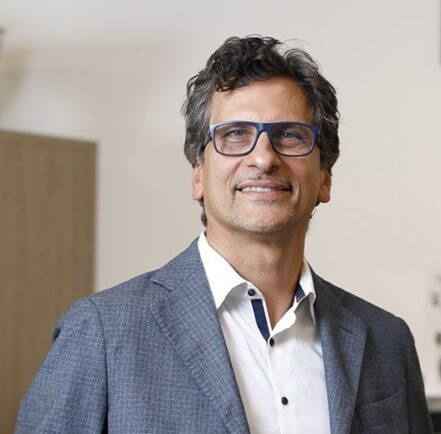


President & CEO, Electrolux Professional Group
Since May 2026 Paolo Schira has been President and CEO of Electrolux Professional Group. He joined the company in 2006 and led Business Area Laundry before taking up his current role. Electrolux Professional Group is one of the leading global providers of laundry, food service and beverage solutions for professional users, with sales in more than 110 countries.
1. Would you agree that market demand for the next decades is quite attractive, and that it is up to the PTC industry to offer good solutions?
Yes. The demand is there. What remains to be seen is whether we, as an industry, deliver.
I joined Electrolux Professional in 2006. Back then, customers asked about productivity and cost. They still do. Today they also ask about water, energy, chemicals, and who will run the machines tomorrow.
The drivers behind our industry are getting stronger, not weaker. Textiles need to last longer. Resources must be used more carefully. Businesses must do more with fewer people. Each of these plays to the strengths of professional textile care.
What decides who wins is simple. A good solution pays back in the customer’s own numbers: cost per kilo, uptime, and resource savings that can be verified. Technology that does not show up in those numbers is just a brochure.
That is the thinking behind Generation 7000, the new laundry platform we launched in September 2026. I am convinced it is one of the most significant steps our industry has taken in many years. But that is not for me to declare. Our customers will judge it in their own numbers. That is exactly the test we designed it for.
That is the standard we hold ourselves to, together with the dealers and service partners who sell, install and maintain our equipment in more than 110 countries.
2. Which factors would you say will have the most effect on our industry over the next 25 years?
Three. And they reinforce each other.
The first is sustainability. Twenty years ago it was a differentiator. Today it is an expectation. Tomorrow it will be a license to operate, written into regulation and into every tender.
The second is labor. In almost every market I visit, operators tell me the same thing: finding and keeping skilled people is getting harder. That includes the technicians who keep machines running. Automation and connectivity are no longer optional.
The third is data. Machines are moving from performing a task to reporting on it: what they consumed, how they performed, and when they will need attention. That changes how a laundry is managed.
Together, these three shift the conversation from the machine to the full life of the installation. Customers will judge us less on the day of purchase and more on the years that follow.
3. Sustainability and circularity offer great opportunities. Do you agree, and do you feel the industry can take advantage of them?
Strongly. Our industry practiced circularity long before the word became fashionable.
Every day, professional textile care extends the life of garments, uniforms and linen. That is circularity in practice.
I have watched this change from the inside. In 2005, our lagoon® wet-cleaning system became the first to be endorsed by The Woolmark Company for delicate wool garments labeled dry-clean only. Many saw wet cleaning as a niche then. Today, lagoon® Advanced Care can replace a dry-cleaning machine one for one. Independent tests by the Hohenstein Institute show results on par with solvent cleaning.
The next step is to apply the same logic to the machines themselves. In April 2026 we launched R+vive, our first remanufactured commercial washer. Used machines are taken back, fully disassembled and rebuilt in our Ljungby factory in Sweden to the standard of our current Line 6000 range. They are tested for 30,000 cycles and carry our warranty. Their circularity score is more than double that of an equivalent new machine.
This is only possible because we made our washers modular back in 1999. Circularity is decided at the drawing board, decades before the machine comes back. Our take-back program across Europe now gives operators and dealers a reason to return older machines instead of scrapping them.
The challenge for all of us is visibility. We must prove the value of longer textile life, and longer machine life, with data that customers, brands and policymakers can trust. Measure, verify, then tell.
4. We foresee that machines will eventually take over the work of people almost completely in the PTC industry. To what extent do you see that happening by 2050?
Much more of the work, yes. Almost all of it, no.
By 2050, sorting, loading, dosing, process control, quality checks and logistics will increasingly be handled by intelligent systems. Automation now pays back against the cost of labor. More and more, it will be built into the equipment itself rather than added on top.
But successful laundries will not be people-free. Every wave of automation I have seen moved people to more valuable work. It did not remove them.
The best businesses will still need professionals who understand their customers, run complex operations and make the call when something unexpected happens. The same holds for service. Connectivity already lets a technician see a machine’s status remotely. The goal is that the right technician arrives with the right part, the first time. That makes the technician more valuable, not less.
Technology should take away the repetitive and the physically hard work. That is why our new Generation 7000 machines carry a 5-Star ErgoCert rating: they are designed to reduce strain, fatigue and repetitive movements for operators. They are designed for service partners too. Generation 7000 brings a new approach to modular design, built on fundamentally fewer and standardized components. The result is equipment engineered for maximum durability and uptime, and simpler to maintain. Judgment, expertise and relationships will remain human.
5. Do you believe the development of more circular textiles will block the trend towards more advanced textiles with special functionalities?
No. The two will move together, and professional textile care is where they meet.
Demand for functional textiles will keep growing: protective workwear, high-visibility garments, technical fabrics for healthcare and hospitality. At the same time, every one of these products will have to last longer and become easier to recycle.
Combining performance with circularity is first a challenge for textile makers. But it does not end at the factory gate. A functional garment that loses its function after a few dozen washes is not circular. It is waste with a delay.
That puts the care process at the center. Every new fiber, coating or membrane needs a process that cleans it without damaging what makes it special. That is why our own textile specialists develop the wash programs in our machines, and why gentle, water-based processes like wet cleaning matter more as textiles become more advanced.
Innovation will let both trends progress. Our industry decides whether the garment keeps its promise over its whole life.
6. Which technologies are most critical to achieve a “closed loop” in processing for specific clients?
No single technology will do it. The closed loop comes from combining several, and from measuring all of them.
A true closed loop needs water recycling, heat recovery, precise chemical dosing and process automation. Each exists today in some form. The gain comes from making them work as one system, tuned to the client. A hospital laundry has different priorities from a hotel or a workwear provider.
The piece most often underestimated is data. You cannot close a loop you cannot measure.
Operators will need to see consumption per cycle in real time, adjust processes automatically, and prove their environmental and hygiene performance to their own customers. Our OnE Connected platform already does part of this. It brings washers, dryers and ironers onto one platform and tracks time and temperature in every cycle. Laundry managers, detergent partners and service technicians work from the same view. In healthcare, hygiene compliance becomes a record, not a promise.
Generation 7000 takes this a step further. Its Adaptive Cycle Process automatically adjusts water, detergent and energy to the actual load. And the machines receive software improvements over the air through OnE Connected, so they keep getting better after they are installed.
And it must be secure. Connected equipment is only valuable if the customer trusts how the data is handled. That is why OnE Connected is built on the ISO 27001 information security standard.
The closed-loop laundry of the future will be as much about information as about machines.
7. In which PTC market areas will these trends move fastest?
Healthcare first, then hospitality and workwear. Each for a different reason.
Healthcare moves fastest because hygiene is not negotiable. Infection control, traceability and sustainability targets all point the same way: validated processes, documented for every cycle.
Barrier washers that physically separate soiled and clean linen are already standard in many hospitals. Connected process records will become standard too.
Hospitality moves fast because of labor. Hotels need more output from fewer people, and their guests and owners expect visible environmental performance. Compact, automated, easy-to-operate on-premises laundries will win there.
Workwear and industrial laundries move fast because of scale. When you process tons of textiles a day, every percent of water, energy or chemicals saved, and every hour of uptime gained, goes straight to the bottom line. Automation and data pay back fastest where volumes are highest.
The common thread is simple. The trend moves fastest wherever the customer can measure the benefit.
8. Emerging markets such as India, Indonesia, the rest of Asia, South America and Africa will show accelerated growth. Do you agree?
Yes. And they have the chance to skip a generation.
Urbanization, a growing middle class, expanding healthcare systems and new hotels are creating demand for professional textile care across Asia, Africa and Latin America.
The opportunity is to build modern infrastructure from the start. A city that is only now opening its first professional laundries does not need to go through the solvent era. It can go straight to wet cleaning, efficient water use and connected equipment, much as many markets skipped the landline and went straight to mobile.
The constraint is rarely the machine. It is people: trained operators and trained technicians. Equipment without a service network behind it is a risk, not an investment. Training for operators, dealers and service partners has to grow at the same pace as installations.
Solutions must also fit local realities: water quality, energy costs, climate and skills. We sell in more than 110 countries and manufacture in Thailand, China and Japan. That proximity teaches us one thing every day: affordable does not have to mean outdated.
9. Will Europe be able to maintain its current leadership in sustainability and circularity?
Yes, if it earns it. Regulation alone will not be enough.
Europe has been the driving force. Its rules on chemicals, energy and circularity pushed the whole value chain to innovate, and European manufacturers and laundries have responded.
But rules set the floor. They do not create leadership. Leadership comes from turning sustainability into something customers want to buy, because it lowers their costs and they can prove it. That is the test Europe has to keep passing.
Other regions, especially in Asia, are moving very quickly, with speed, scale and ambition. That is healthy. Competition makes all of us better.
Our laundry platforms are designed in Ljungby, Sweden, our global laundry R&D center, and sold worldwide. I am confident Europe will keep a leading role if it does three things: invest in innovation, prove impact with data, and stay open to learning from others.
10. What will the world of PTC look like in 2050?
Highly connected, highly automated, and far more resource efficient than today.
Energy, water and chemical use per kilo will keep falling. Many optimization decisions will happen automatically, inside the machine.
Machines will also live several lives. Designed to be remanufactured, upgraded and returned, they will stay in service far longer than today. They will be judged on what they deliver over that whole life, not on the day they are installed.
What I hope changes most is how society sees our industry. Professional textile care should not be seen simply as cleaning clothes. It should be recognized as essential infrastructure for the circular economy: extending product life, reducing waste and making better use of scarce resources.
The industry that proves this with data will earn that recognition. That is the greatest opportunity for all of us: manufacturers, dealers, service partners and operators, together.


