According to a recent report from the United Nations Environment Program (UNEP), the global fashion industry is responsible for 8-10% of global greenhouse gas emissions, more than all international flights and shipping combined.
One of the main sources of this environmental impact is the disposal of unwanted clothing. Synthetic materials in particular are a problem, requiring an estimated 342 million barrels of oil per year to produce.
Europeans throw away 2 million tons of textiles every year. 70% of donated clothing is shipped to Africa for resale on local markets (source Eurostat, Oxfam).
We buy more clothes than ever. One billion items of clothing end up in the waste every year. We buy an average of 46 new items of clothing per year. We have 173 items of clothing in the closet, 50 of which are unworn. We also get rid of another 40 items of clothing per year.
The most beautiful garments stay in the Netherlands, the inferior ones go to Eastern Europe. And the real cast-offs end up in Africa.
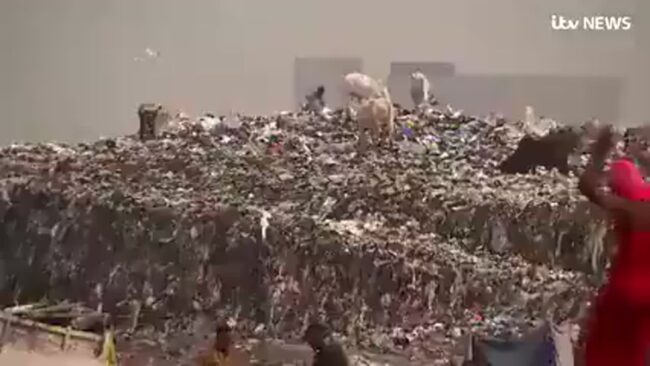
Kenya imports more than 140,000 tons of used clothing per year (source Usaid). Due to declining quality, sometimes as much as 50% of used clothing has to be thrown away. Due to the lack of proper waste management, it ends up in landfills, often at the edges of roads and rivers. Ultimately it ends up in the sewage system or oceans.
Ghana also appears to be a gigantic collection point for our discarded clothing.
West Africa’s largest second-hand clothing market is the Kantmanto market in Accra, Ghana. 20 million discarded garments arrive here every week from Western countries. Research showed that 40% of this leaves the market as waste. Unusable clothing ends up in the sea through sewers, washes up again and becomes buried under the sand. Accra’s beach is littered with them. Another part is dumped on illegal garbage dumps in the area. Waste pickers look for the very last usable clothes, working in toxic burning smells. Many of the clothes are burned in the open air to get rid of them.
Made for low wages in China or Bangladesh, sold in Western countries, hardly worn and quickly discarded. Fast fashion is disastrous for the environment in many ways. Garments are becoming increasingly cheaper and of poorer quality. They are predominantly made of synthetic materials, such as polyester, and can almost never be recycled into new clothing.
Clothes and shoes are bought online en masse, tried out and returned, only to be no longer offered. Collections follow each other at an increasingly rapid pace. In the Netherlands alone, an estimated 1 billion items of clothing are thrown away every year.
Being a textile cleaner of the second generation, he was raised in a family of textile cleaners. Together with his two brothers Dino was eager and ambitious to gain knowledge and develop expertise to do the best possible job in cleaning textiles. In this spirit he took WET CLEANING as an Art to do the impossible in professional textile cleaning beyond customer expectations.
This approach brought Dino Kantzavelos to reach out to colleagues and experts to share his know-how and to stimulate professional wet cleaning in modern textile care. The work of the Canada Fabricare Association was an excellent opportunity to stimulate business development in Canada and create a new future perspective.
A commercial engineer by training, Célestin-Arthur YOBOUE is the general director of the company Horizon Equipements. A company specializing in the study, design and implementation of industrial laundry projects since 2016. Managing Director of Modern Laundries on the Ivory Coast, he designed the linen treatment manual with a view to enabling all players in the medical linen circuit to respect the principles and rules that govern this profession in order to avoid cross-contamination. With this experience, he acquired the trust of several institutions including Jet Expo, Paris, where he represented Africa by hosting a theme on “Laundry in the African economy” in 2019.
In November 2023, he was the speaker principal at TEXCARE France where he speaks on the theme: “Africa, the El Dorado of manufacturers”. In addition to the seminars for which he provides training in Ivory Coast and in several African countries, the Cocody Abidjan university hospital center entrusts its company Horizon Equipements in partnership with the French group ATAUB architect, with the renovation and equipment work of its laundry room in 2020.
He is participating with the General Directorate of Public Hygiene in a reflection on the delegation of public services to 10 reference hospitals in the Abidjan district, on behalf of the Ministry of Health. To this end, he will receive the congratulations of the Ivorian Minister of Health Pierre DIMBA. Célestin-Arthur YOBOUE is also President of << AFRICAN LAUNDRY CONSORTIUM>> and founding Director of the first magazine dedicated to Laundry << AFRICAN LAUNDRY NEWS >>
He initiated in May 2022, the first African forum for textile maintenance professionals (FAPET), whose main objective is to bring together Africans in order to discuss issues, linked on the one hand to the professionalization of the profession and on the other hand to promote it. He was appointed in August 2023 by his peers from Algeria, Cameroon, Tunisia and Togo as President of the African Textile Maintenance Federation (FAPET) with the objectives of structuring, professionalizing and revitalizing the textile care industry in Africa. Our two companies HORIZON EQUIPEMENTS ET LAUNDERIES MODERNES have accumulated a turnover of 991,529,261 FCFA or 1,511,477 Euro over the last 5 years. Our companies are negotiating a fundraising appeal, which will allow us to expand our range of customers in West Africa, our turnover forecast is estimated at 3,971,794,800 FCFA or 6,054,565 Euro for the first 3 years operating.
Mrs. Eva Maria is the President of ASLI, the Indonesia Laundry Association for retail textile cleaners with 1200 members in 21 provinces. Since 2017 she is actively involved in ASLI projects and activities and coordinated the organisation of 3 Indonesia Best Practices Awards so far.
In 2018 she started the ME Laundry TrainingCentre and is CEO of this institute since then. Furthermore she is CEO & Founder of PT Star Technology Digital (Mobile Apps for Market Place Laundry “IZILOH”) since 2019 up till now. Starting this year she will be coordinating the Indonesia Best Practices Awards again, on behalf of ASLI, but also on behalf of APLI (industrial laundries), HIPLI (hospitality) and IlIE (retail). Mrs. Sriulina has been involved in several CINET projects and activities.
Over the last 25 years Peter Wennekes worked within the Professional Textile Care industry being the CEO of the Dutch Associations NETEX (retail), FTN (BtoB) and VEMATEX (suppliers), the Technology Institute TKT, the education foundation TCT, CITV (purchase of energy), Bosatex (soil remediation program) and a variety of other foundations.
Since 2005 Peter was appointed also as CEO of CINET, organizing international research, education, certification and building on a Global Network of Textile Care Professionals. Current focus is on the WORLD CONGRESS and the next edition of the Best Practices Awards to be organized at Texcare International in November 2024.
Christoph Richter is an experienced professional with a proven track record in business management and development within the PTC industry. Currently, he holds the position of Managing Director of the Textile Care division at Chemische Fabrik Kreussler & Co. GmbH, where he assumes the responsibility of guiding the company’s strategic direction and overseeing operational functions, as well as systematically expanding Kreussler’s excellent market position worldwide.
Prior to his role as Managing Director, he was working at Electrolux Professional, where he served as the Director of Business Development – BA Laundry. During his tenure at Electrolux Professional, he held various crucial positions, including Global Segment Manager Consumer Operated & Cleaning Shops for a period of three years, and Global Segment Manager Laundry B2C for about four years. In these roles, he played a significant role in fostering growth and development within the Laundry division.
Before his time at Electrolux Professional, he was already an integral part of the team at Chemische Fabrik Kreussler GmbH & Co KG, where he served as the Head of Sales and played a pivotal role in driving sales expansion. His responsibilities also included Business Development International from 2008 to 2012.
Mrs. Jan Barlow is owner of Jan’s Professional Cleaners in Clio Michigan since 1982.
Starting 1984 she became a member of the Drycleaning and Laundry Institute (DLI) and fulfilled a wide variety of functions and tasks, such as District Chair, member of the Executive Committee and President. Additionally she actively participated in many other organizations, amongst them the National Fire Protection Association International and the Women’s Business Enterprise National Council (WBENC). Further more she supported a wide variety of projects and initiatives.
Jan Barlow was granted many certifications and awards, including the Award of Excellence-Seal of Approval-DLI, the Association of Wedding Gown Specialists-Jack Barth Award of Excellence and last but not least the CINET Global Overall Award for Retail Textile Cleaners for Small Business Enterprises in 2022.
Since June 2015, he heads the Hessnatur Foundation as CEO. Rolf Heimann has been active for 30 years in the field of textile ecology. For example, in the nineties, he led a company that produced ecological dye stuff, long before the term sustainability was even used in the industry.
Already back in 2002 until 2010, he was active in the executive board of IVN (International Association for Natural Textiles) and part of the IVN research and guidance committee as well as a joint founder of the international textile standard GOTS (Global Organic Textile Standard). Since the nineties, he was a partner at a sustainability consultancy for the textile industry with offices in Istanbul and later also in Hong Kong.
From 2002-2015, Rolf Heimann was the Head of Corporate Responsibility at Hess Natur-Textilien GmbH, the German leader in sustainable fashion. During this time and until today, many successes in introducing products to a niche market were achieved. The connecting element in all of these projects is that under challenging circumstances, products (e.g., from small-scale businesses and/or from developing countries) were produced and further developed to suit the European market’s demand.
From 2011-2018, he was the founder of and tutor at the master program Sustainability in Fashion at ESMOD Berlin. Thanks to his unique and extensive experience, Rolf Heimann is a frequently requested keynote speaker and participant at panel discussions regarding applied sustainability in the textile industry.
Sanjay Sauldie, born in India and raised in Germany, embarked on an academic journey in mathematics and computer science at the University of Cologne. He further honed his expertise by achieving a Master of Sciences (M.Sc.) at the University of Salford, Manchester, specializing in digital disruption and transformation in 2017. A year later, he was trained at EMERITUS, Singapore, in the MIT method of design thinking. Today, Sanjay serves as the Director of the European Digital Business Institute EDBIA
His exceptional contributions have been recognized internationally with the prestigious “Golden Web Award” from the World Association of Webmasters in Los Angeles, USA, and he has twice received the “Innovation Award” from the Initiative Mittelstand, making him one of Europe’s most sought-after experts on digitalization in businesses and society. Sanjay ignites a dazzling array of practical insights in his talks and seminars. He uniquely can demystify the complex world of digitalization in terms anyone can understand. His vivid language captivates audiences, inspiring them to immediately put his valuable tips into action – making him an extraordinary asset to any event!
Working for one of Europe’s leading financial institutions, Mischa has a thorough understanding of business models and their need for continuous evolution. Recently he specialized in the challenges and opportunities posed by climate change for both the financial industry and its customers. In addition, Mischa has a wealth of experience as a moderator and is looking forward to guide you through this truly important, global event.